


Page 219 - Freshwater-Biology-and-Ecology-Handbook
P. 219
3.1.2  Diversity indices


            Diversity indices were popular in the 1970s. Diversity
            indices are a more complex refinement of measures of
            taxonomic richness that also take account of the pattern of
            distribution of abundances across the taxa, principally the
            evenness of abundances. They were originally developed
            in the search for parameters that encapsulated the
            properties of ecological communities. Pollution and other
            environmental pressures are usually associated with less
            even distributions: in stressed environments, many taxa
            cannot cope so are absent, but the few tolerant taxa that can
            occur do so in greater abundance because of the reduced
            competition. The classic example is severe organic pollution
            in which the few species that can tolerate very low oxygen
            concentrations and silt are found in very great abundance,
            supported by the nutrition provided by the organic matter
            and the bacteria that also thrive on it.                                             Asellus aquaticus
            Because of their more complex derivation, diversity
            indices are more difficult to interpret – in simplest terms
            because they confound richness and evenness, but
            more fundamentally because the properties of biological
            communities that they attempt to describe are themselves
            complex and only partially understood (Green 1979).  (72)  It
            is much easier to interpret separate measures of richness
            (such as number of taxa) and evenness – of which the most
            widely used is that by Pielou (1969)  (73)  – in the same way
            that it is easier to interpret WHPT ASPT and WHPT NTaxa
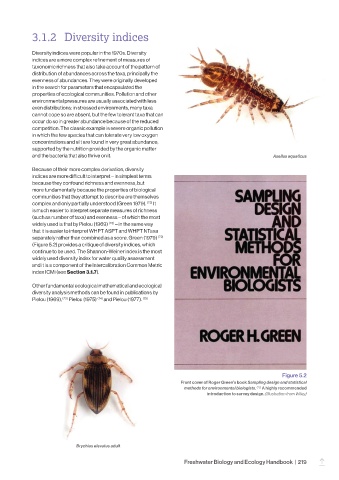
            separately rather than combined as a score. Green (1979)  (72)
            (Figure 5.2) provides a critique of diversity indices, which
            continue to be used. The Shannon-Weiner index is the most
            widely used diversity index for water quality assessment
            and it is a component of the Intercalibration Common Metric
            index ICMi (see Section 3.1.7).

            Other fundamental ecological mathematical and ecological
            diversity analysis methods can be found in publications by
            Pielou (1969),  (73)  Pielou (1975)  (74)  and Pielou (1977).  (75)


                                                                                                    Figure 5.2
                                                                 Front cover of Roger Green’s book Sampling design and statistical
                                                                  methods for environmental biologists.   A highly recommended
                                                                                           (72)
                                                                          introduction to survey design. (Illustration from Wiley)


                            Brychius elevatus adult

                                                                  Freshwater Biology and Ecology Handbook  |  219
                                                                                                                 –

