


Page 105 - Freshwater-Biology-and-Ecology-Handbook
P. 105
10


                                                                      COLLECTING

                                                                       FIELD DATA


                                                           Invertebrate samples should always be accompanied
                                                           by observations made in the field to help interpret
                                                           the invertebrate data, in addition to the field
                                                           measurements necessary for RIVPACS (Section 7.6).
                                                           This includes observations about the presence of rare
                                                           or invasive species, the physical structure of the site
                                                           and surrounding land use, the habitats present, any
                                                           indicators of pollution or physical degradation and any
                                                           difficulties collecting the sample, particularly if they
                                                           could affect its quality.


                                                           Photographs are most useful and should always be taken
                                                           when invertebrate samples are collected. Concentrate on the
                                                           surroundings to put the site into context when photographing
                                                           sites. Photographs that concentrate on the water surface without
                                                           the surroundings do not convey much information. Underwater
                                                           photographs taken with waterproof cameras on the end of a
                                                           pole (such as a pond net handle) that show the condition of the
                                                           riverbed are also particularly useful. These photographs should
                                                           be stored electronically to help interpret any changes observed
                                                           in the river invertebrate data. Photographs are always useful and
                                                           are often vital in reports.

                                                           Larger rare species of invertebrates must be recorded in the
                                                           field and returned to the site immediately. This includes animals
                                                           such as the medicinal leech, native white-clawed crayfish, and
                                                           pearl mussels. Amphibians and fish should also be recorded and
                                                           returned immediately.

                                                           Water chemistry measurements taken by simple hand-held
                                                           meters are also useful, particularly pH, conductivity, temperature,
                                                           and oxygen concentration. Electronic field meters must be
                                                           calibrated periodically, to ensure that they remain accurate.

                                                           This supplementary environmental information is useful for
                                                           interpreting your results, even if it is not to be analysed using
                                                           RIVPACS tools.
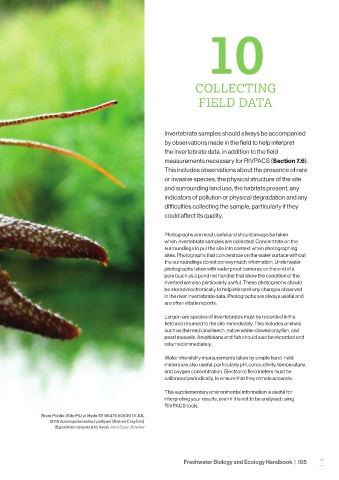
                River Piddle (Site P4) at Hyde SY 86475 90639 15 JUL
                  2015 Austropotamobius pallipes (Native Crayfish)
                    (Specimen returned to river) John Davy-Bowker


                                                                  Freshwater Biology and Ecology Handbook  |  105
                                                                                                                 –

