


Page 106 - Freshwater-Biology-and-Ecology-Handbook
P. 106
CHAPTER 2     10.1  10.1   Site description form


            Site description forms are useful for recording information and to help surveyors locate sampling sites.

            Photographs are particularly useful for this, and if a site is hidden, for example, behind buildings, it is helpful to include
            photographs from the road or parking place showing the route to the site, even though they don’t show the site itself.
            Photographs of the sampling site must include its surroundings.

            The forms should also include information about health and safety issues at the site, who to contact to gain access and their
            contact details, what type of sampling or other equipment may be needed, and the presence of alien invasive species requiring
            additional biosecurity measures. Copies of these forms should be used when sampling, but ensure the original documents are
            safe in the laboratory if they are not stored electronically.


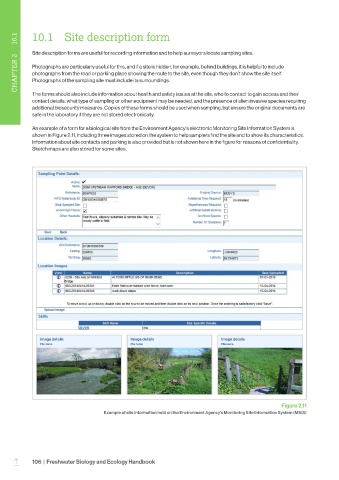
            An example of a form for a biological site from the Environment Agency’s electronic Monitoring Site Information System is
            shown in Figure 2.11, including three images stored on the system to help samplers find the site and to show its characteristics.
            Information about site contacts and parking is also provided but is not shown here in the figure for reasons of confidentiality.
            Sketch maps are also stored for some sites.


               Image details                   Image details                   Image details
               File name                       File name                       File name


                                                                                                    Figure 2.11
                                     Example of site information held on the Environment Agency’s Monitoring Site Information System (MSIS)


            106  |  Freshwater Biology and Ecology Handbook
      –

