


Page 14 - Freshwater-Biology-and-Ecology-Handbook
P. 14
Biological Pressures                       Morphological Pressures
                                  Invasives                                     Substrate
                                Biogeography                             Channel section/sinuosity
       PREFACE             Bio-manipulation/stocking                           Connectivity
                            Disease/predation/prey
                                                                               Depth/area
                                 Productivity
                                                                                Shading


                                                                                         Climate Change
                    Season                            Ecosystem                            Global warming
                   Geography                             Health                         North Atlantic Oscillation
                                                                                               El Niño


                            Chemical Pressures
                                                                        Hydrological Pressures
                              Concentration /load                         Velocity/residence time
                               Alkalinity/acidity                         Discharge/intermittence
                                 Bioavailability                              Flood/drought
                                 Temperature                                Flow duration curve
                                   Toxicity
                                   Oxygen                                 Drainage/impoundment

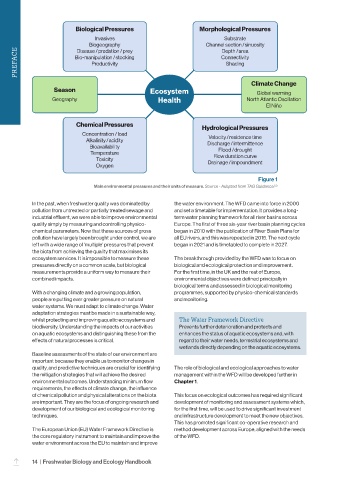
                                                                                            Figure 1
                                  Main environmental pressures and their units of measure. Source - Adapted from TAG Guidance.  (2)


            In the past, when freshwater quality was dominated by   the water environment. The WFD came into force in 2000
            pollution from untreated or partially treated sewage and   and set a timetable for implementation. It provides a long-
            industrial effluent, we were able to improve environmental   term water planning framework for all river basins across
            quality simply by measuring and controlling physico-  Europe. The first of three six-year river basin planning cycles
            chemical parameters. Now that these sources of gross   began in 2010 with the publication of River Basin Plans for
            pollution have largely been brought under control, we are   all EU rivers, and this was repeated in 2015. The next cycle
            left with a wide range of ‘multiple’ pressures that prevent   began in 2021 and is timetabled to complete in 2027.
            the biota from achieving the quality that maximises its
            ecosystem services. It is impossible to measure these   The breakthrough provided by the WFD was to focus on
            pressures directly on a common scale, but biological   biological and ecological protection and improvement.
            measurements provide a uniform way to measure their   For the first time, in the UK and the rest of Europe,
            combined impacts.                                 environmental objectives were defined principally in
                                                              biological terms and assessed in biological monitoring
            With a changing climate and a growing population,   programmes, supported by physico-chemical standards
            people are putting ever greater pressure on natural   and monitoring.
            water systems. We must adapt to climate change. Water
            adaptation strategies must be made in a sustainable way,
            whilst protecting and improving aquatic ecosystems and   The Water Framework Directive
            biodiversity. Understanding the impacts of our activities   Prevents further deterioration and protects and
            on aquatic ecosystems and distinguishing these from the   enhances the status of aquatic ecosystems and, with
            effects of natural processes is critical.           regard to their water needs, terrestrial ecosystems and
                                                                wetlands directly depending on the aquatic ecosystems.
            Baseline assessments of the state of our environment are
            important because they enable us to monitor changes in
            quality, and predictive techniques are crucial for identifying   The role of biological and ecological approaches to water
            the mitigation strategies that will achieve the desired   management within the WFD will be developed further in
            environmental outcomes. Understanding minimum flow   Chapter 1.
            requirements, the effects of climate change, the influence
            of chemical pollution and physical alterations on the biota   This focus on ecological outcomes has required significant
            are important. They are the focus of ongoing research and   development of monitoring and assessment systems which,
            development of our biological and ecological monitoring   for the first time, will be used to drive significant investment
            techniques.                                       and infrastructure development to meet the new objectives.
                                                              This has promoted significant co-operative research and
            The European Union (EU) Water Framework Directive is   method development across Europe, aligned with the needs
            the core regulatory instrument to maintain and improve the   of the WFD.
            water environment across the EU to maintain and improve


            14  |  Freshwater Biology and Ecology Handbook
      –

