


Page 178 - Freshwater-Biology-and-Ecology-Handbook
P. 178
CHAPTER 3     6 – 7  The UK government has set these acidification class   Although acid deposition is a problem in some parts of

            boundaries in statutory directions in The Water Framework
                                                              England (the Pennines and Dartmoor), the method has not
                                                              been optimised for use in England because no English data
            Directive (Standards and Classification) Directions (England
                                                              was used in its development. It was therefore not possible to
            and Wales) 2015 (download from link at https://www.
                                                              check the acidification typology for England. The few data
            legislation.gov.uk/uksi/2015/1623/resources), and the
            Scottish Government in The Scotland River Basin District
                                                              from England that were available were closest structurally
                                                              and functionally to those from Welsh sites.
            (Standards) Directions 2014 and for the Solway and Tweed,
            which have separate legislation as cross-border river
            basins, in The Solway Tweed River Basin District (Standards)
            (Scotland) Directions 2014, both of which can be downloaded   It is recommended that users in England use the reference
                                                              typology developed for Wales, and this is reflected in the
            from https://www.gov.scot/publications/water-     statutory directions in The Water Framework Directive
            environment-legislation/. No status acidification class   (Standards and Classification) Directions (England and Wales)
            boundaries have been developed explicitly for English sites.   2015, download from link at http://www.legislation.gov.
                                                              uk/uksi/2015/1623/resources English uplands are in a
            Dissolved Organic Carbon (DOC) data is needed to   different hydro-ecoregion (Figure 3.13), so the acidification
            differentiate humic (coloured) from clear waters. Lack of data   classification based on Welsh reference values should be
            made it impossible to test whether there was also a difference   used with caution in England.
            in sensitivity between these two types of environment in
            Wales (and England), so there are further grounds for using   The High/Good and Good/Moderate status class
            WFD AWIC with caution in England if the water is humic.   boundaries for WFD AWIC  have been intercalibrated, but
                                                                                  sp
            DOC is not monitored widely in England, so data is not   only with Norway: Commission Decision (EU) 2018/229  (54)
            always available.                                 at https://www.legislation.gov.uk/eudn/2018/229/
                                                              annex/division/1/division/5/division/2/adopted.
            McFarland (2010)  also indicated that Cantrell Acid   Intercalibration data for North GIG rivers at: http://www.
                          (51)
            Neutralising Capacity (ANC, Cantrell et al. 1990  ) was   freshwatermetadata.eu/metadb/pdf/BFE_50-Northern_
                                                (52)
            needed for the typology, but this requirement was removed   GIG_Rivers_Macoinvertebrates_acidification_data_
            from the definitive method. However, ANC is still useful in   WFD_Intercalibration.pdf. One outcome from that work
            acidification studies because there is a UK chemical standard   was a wider comparison of methods by Moe et al. (2010).  (55)
            based on that parameter: download link to the standards
            from https://www.legislation.gov.uk/uksi/2015/1623/
            resources

            Poor WFD AWIC  class indicates that acid deposition may
                         sp
            be causing an impact, but it cannot confirm it. WFD AWIC sp
            will also respond to other pressures including toxic metal
            pollution, which is common in mine drainage. When WHPT
            NTaxa is very small, the precision WFD AWIC  will be low.
                                               sp
            The official definition of the acidification classification can
            be found in UK TAG’s method statements, which can be
            downloaded from UK TAG website http://www.wfduk.org/
            resources/category/biological-standard-methods-201
            Technical guidance for calculating the acidification
            classification is described in documents on UK TAG’s website
            http://www.wfduk.org/ follow the link 'Biological Standard
            Methods: for Rivers – Invertebrates (General Degradation)'
            select River Invertebrates AWIC UKTAG Method
            Statement.pdf and WFD-AWIC Calculation sheet.xls.


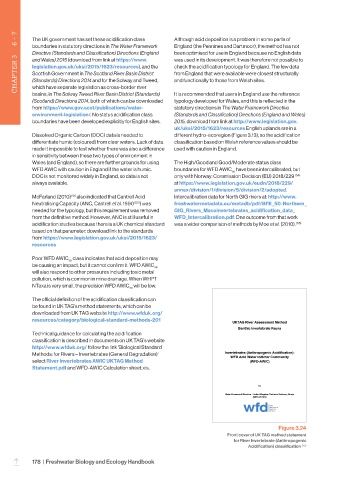
                                                                                                   Figure 3.24
                                                                                 Front cover of UK TAG method statement
                                                                                   for River Invertebrate (Anthropogenic
                                                                                        Acidification) classification  (53)

            178  |  Freshwater Biology and Ecology Handbook
      –

