


Page 185 - Freshwater-Biology-and-Ecology-Handbook
P. 185
Other evidence                                    Other evidence


                                                        Reporting

                              Data analysis                                        Data
                              biotic indices                                     analysis &
                                & status                                         diagnosis
                              classification
                                              Compliance
               Laboratory                        with            Programme                      Laboratory
                analysis     Surveillance      objectives        of measures                     analysis
                                  and          PASS  FAIL                      Investigative
                              operational                                       monitoring
                              monitoring


                        Field                                                                Field
                                                                                             Field
                                                                                          monitoring
                     monitoring                                                           monitoring
                                                                                           and data
                      and data            Review                         Review            and data
                      collection                                                           collection
                                                                                           collection


                       WFD status classification                            Non-classification


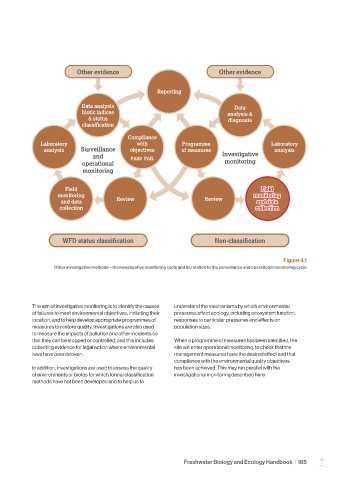
                                                                                                     Figure 4.1
                    Other investigative methods – the investigative monitoring cycle and its relation to the surveillance and operational monitoring cycle


            The aim of investigative monitoring is to identify the causes   understand the mechanisms by which environmental
            of failures to meet environmental objectives, including their   pressures affect ecology, including ecosystem function,
            location, and to help develop appropriate programmes of   responses to particular pressures and effects on
            measures to restore quality. Investigations are also used   population sizes.
            to measure the impacts of pollution and other incidents so
            that they can be stopped or controlled, and this includes   When a programme of measures has been identified, the
            collecting evidence for legal action where environmental   site will enter operational monitoring, to check that the
            laws have been broken.                            management measures have the desired effect and that
                                                              compliance with the environmental quality objectives
            In addition, investigations are used to assess the quality   has been achieved. This may run parallel with the
            of environments or biotas for which formal classification   investigational monitoring described here.
            methods have not been developed and to help us to


                                                                  Freshwater Biology and Ecology Handbook  |  185
                                                                                                                 –

