


Page 93 - Freshwater-Biology-and-Ecology-Handbook
P. 93
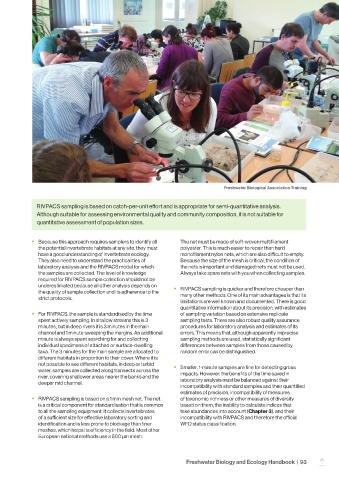
Freshwater Biological Association Training

              RIVPACS sampling is based on catch-per-unit effort and is appropriate for semi-quantitative analysis.
              Although suitable for assessing environmental quality and community composition, it is not suitable for
              quantitative assessment of population sizes.


            •  Because this approach requires samplers to identify all   The net must be made of soft-woven multifilament
              the potential invertebrate habitats at any site, they must   polyester. This is much easier to repair than hard
              have a good understanding of invertebrate ecology.   monofilament nylon nets, which are also difficult to empty.
              They also need to understand the practicalities of   Because the size of the mesh is critical, the condition of
              laboratory analysis and the RIVPACS model for which   the nets is important and damaged nets must not be used.
              the samples are collected. The level of knowledge   Always take spare nets with you when collecting samples.
              required for RIVPACS sample collection should not be
              underestimated because all other analysis depends on   •  RIVPACS sampling is quicker and therefore cheaper than
              the quality of sample collection and its adherence to the   many other methods. One of its main advantages is that its
              strict protocols.
                                                                limitations are well known and documented. There is good
                                                                quantitative information about its precision, with estimates
            •  For RIVPACS, the sample is standardised by the time   of sampling variation based on extensive replicate
              spent actively sampling. In shallow streams this is 3   sampling tests. There are also robust quality assurance
              minutes, but in deep rivers it is 3 minutes in the main   procedures for laboratory analysis and estimates of its
              channel and 1 minute sweeping the margins. An additional   errors. This means that, although apparently imprecise
              minute is always spent searching for and collecting   sampling methods are used, statistically significant
              individual specimens of attached or surface-dwelling   differences between samples from those caused by
              taxa. The 3 minutes for the main sample are allocated to   random error can be distinguished.
              different habitats in proportion to their cover. Where it is
              not possible to see different habitats, in deep or turbid
              water, samples are collected along transects across the   •  Smaller, 1-minute samples are fine for detecting gross
              river, covering shallower areas nearer the banks and the   impacts. However, the benefits of the time saved in
              deeper mid channel.                               laboratory analysis must be balanced against their
                                                                incompatibility with standard samples and their quantified
                                                                estimates of precision, incompatibility of measures
            •  RIVPACS sampling is based on a 1 mm mesh net. The net   of taxonomic richness or other measures of diversity
              is a critical component for standardisation that is common   based on them, the inability to calculate indices that
              to all the sampling equipment. It collects invertebrates   take abundances into account (Chapter 3), and their
              of a sufficient size for effective laboratory sorting and   incompatibility with RIVPACS and therefore the official
              identification and is less prone to blockage than finer   WFD status classification.
              meshes, which helps its efficiency in the field. Most other
              European national methods use a 500 μm mesh.


                                                                  Freshwater Biology and Ecology Handbook  |  93
                                                                                                                 –

