


Page 96 - Freshwater-Biology-and-Ecology-Handbook
P. 96
CHAPTER 2     7.1 – 7.2  7.1  Manual search


            The 1-minute manual search always
            accompanies the main sample.

            It is done to collect individual specimens of species
            that are unlikely to be collected in the main sample – in
            particular, surface-dwelling animals such as pond skaters
            and water crickets which move away rapidly from any
            disturbance, and for animals attached to rocks and other
            firm surfaces – in particular, limpets, blackfly pupae and
            certain caddis larvae and pupae. The search will not
            always be fruitful but must always be undertaken.
            The 1-minute search may be split into an initial search for
            surface-dwellers before you enter the stream, as these
            are very sensitive to disturbance of the water surface, and
            a subsequent search for attached animals on large stones
            and other objects from the riverbed.


            7.2  3-minute kick

            sampling from shallow

            rivers


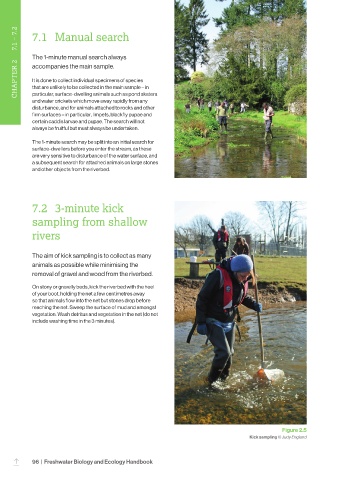
            The aim of kick sampling is to collect as many
            animals as possible while minimising the
            removal of gravel and wood from the riverbed.

            On stony or gravelly beds, kick the riverbed with the heel
            of your boot, holding the net a few centimetres away
            so that animals flow into the net but stones drop before
            reaching the net. Sweep the surface of mud and amongst
            vegetation. Wash detritus and vegetation in the net (do not
            include washing time in the 3 minutes).


                                                                                                    Figure 2.5
                                                                                         Kick sampling © Judy England


            96  |  Freshwater Biology and Ecology Handbook
      –

