


Page 99 - Freshwater-Biology-and-Ecology-Handbook
P. 99
On loose riverbed substrates, leave the air flowing and move
            the airlift continuously across the riverbed.


            On more compacted substrates, sample in a series of short
            bursts in different locations by turning the air supply on
            and off and bouncing the airlift to help disturb the riverbed.
            Whichever method you use, you must aim to sample the
            habitats present in proportion to their cover.
            Supplement the airlift sample from the main channel with a
            1-minute marginal sweep (Section 7.5).
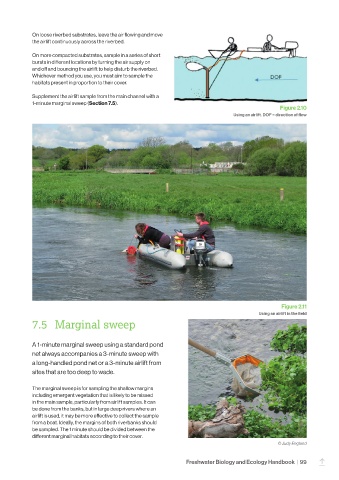
                                                                                                   Figure 2.10
                                                                                   Using an airlift. DOF = direction of flow


                                                                                                    Figure 2.11
                                                                                            Using an airlift in the field
            7.5  Marginal sweep


            A 1-minute marginal sweep using a standard pond
            net always accompanies a 3-minute sweep with
            a long-handled pond net or a 3-minute airlift from
            sites that are too deep to wade.

            The marginal sweep is for sampling the shallow margins
            including emergent vegetation that is likely to be missed
            in the main sample, particularly from airlift samples. It can
            be done from the banks, but in large deep rivers where an
            airlift is used, it may be more effective to collect the sample
            from a boat. Ideally, the margins of both riverbanks should
            be sampled. The 1 minute should be divided between the
            different marginal habitats according to their cover.
                                                                                                   © Judy England

                                                                  Freshwater Biology and Ecology Handbook  |  99
                                                                                                                 –

