


Page 115 - Freshwater-Biology-and-Ecology-Handbook
P. 115
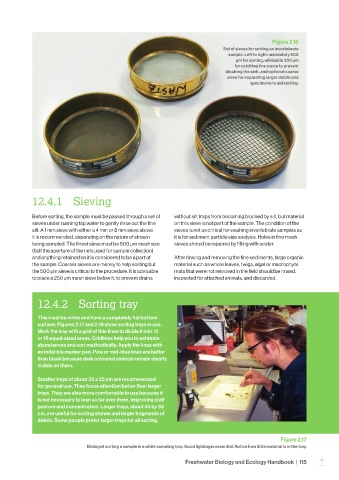
Figure 2.16
                                                                               Set of sieves for sorting an invertebrate
                                                                                 sample. Left to right: mandatory 500
                                                                                    μm for sorting, advisable 250 μm
                                                                                   for catching fine waste to prevent
                                                                                blocking the sink, and optional coarse
                                                                                 sieve for separating larger debris and
                                                                                         specimens to aid sorting.


            12.4.1   Sieving


            Before sorting, the sample must be passed through a set of   without silt traps from becoming blocked by silt, but material
            sieves under running tap water to gently rinse out the fine   on this sieve is not part of the sample. The condition of the
            silt. A 1 mm sieve with either a 4 mm or 8 mm sieve above   sieves is not as critical for washing invertebrate samples as
            it is recommended, depending on the nature of stream   it is for sediment particle size analysis. Holes in fine mesh
            being sampled. The finest sieve must be 500 μm mesh size   sieves should be repaired by filling with solder.
            (half the aperture of the nets used for sample collection)
            and anything retained on it is considered to be a part of   After rinsing and removing the fine sediments, large organic
            the sample. Coarser sieves are merely to help sorting but   material such as whole leaves, twigs, algal or macrophyte
            the 500 μm sieve is critical to the procedure. It is advisable   mats that were not removed in the field should be rinsed,
            to place a 250 μm mesh sieve below it, to prevent drains   inspected for attached animals, and discarded.


              12.4.2   Sorting tray


              This must be white and have a completely flat bottom
              surface. Figures 2.17 and 2.18 show sorting trays in use.
              Mark the tray with a grid of thin lines to divide it into 12
              or 16 equal-sized areas. Gridlines help you to estimate
              abundances and sort methodically. Apply the lines with
              an indelible marker pen. Pale or mid-blue lines are better
              than black because dark coloured animals remain clearly
              visible on them.
              Smaller trays of about 35 x 25 cm are recommended
              for general use. They focus attention better than larger
              trays. They are also more comfortable to use because it
              is not necessary to lean so far over them, improving staff
              posture and concentration. Larger trays, about 45 by 35
              cm, are useful for sorting stones and larger fragments of
              debris. Some people prefer larger trays for all sorting.


                                                                                                    Figure 2.17
                                Biologist sorting a sample in a white sampling tray. Good lighting is essential. Notice how little material is in the tray.

                                                                  Freshwater Biology and Ecology Handbook  |  115
                                                                                                                 –

