


Page 118 - Freshwater-Biology-and-Ecology-Handbook
P. 118
CHAPTER 2     12.5 – 12.6  12.5   Identification       The main differences in sensitivities of species within a genus


            For environmental quality assessment, family is generally the
            minimum level of identification based on the taxa included
                                                              or family often involve the natural environmental pressures
                                                              that determine their habitat, such as substrate and stream
            in the WHPT index. That enables WFD quality status to
                                                              size. To summarise: you need to decide on the diagnostic
            be established and it is also sufficient for the calculation
            of a number of other biotic indices to help diagnose
                                                              indices you want to apply, as different diagnostic indices
            environmental pressures.
                                                              Despite being particularly useful for environmental
            Species-level analysis provides more data from which
                                                              assessment, some species, including Oligochaeta and
            to diagnose environmental degradation. This may   require different levels of identification.
            provide greater accuracy necessary to detect emerging   Chironomidae are difficult to identify. An operational
            environmental pressures that have more subtle impacts,   compromise, known as ‘mixed taxon analysis’, is used
            such as climate change, the impacts of some invasive   to identify groups that are readily identifiable to species,
            species, and morphology. Species-level identification   and to identify other groups to a higher level. This is the
            is generally needed for conservation analysis. However,   standard level of analysis used by the Environment Agency.
            its advantages for environmental assessment are often   In addition to advantages already mentioned for species-
            overstated. Precision is limited by sampling and the response   level identification, it provides information from which to
            of many species to common anthropogenic environmental   develop improved indices, and to assess the impacts of
            pressures such as organic enrichment is similar to that of   new pressures such as climate change and alien invasive
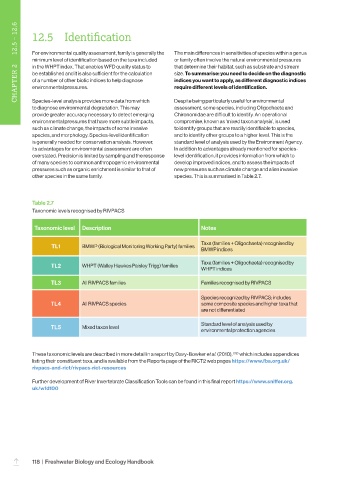
            other species in the same family.                 species. This is summarised in Table 2.7.


            Table 2.7
            Taxonomic levels recognised by RIVPACS

             Taxonomic level  Description                               Notes


                                                                        Taxa (families + Oligochaeta) recognised by
                   TL1        BMWP (Biological Monitoring Working Party) families
                                                                        BMWP indices
                                                                        Taxa (families + Oligochaeta) recognised by
                   TL2        WHPT (Walley Hawkes Paisley Trigg) families
                                                                        WHPT indices
                   TL3        All RIVPACS families                      Families recognised by RIVPACS


                                                                        Species recognized by RIVPACS; includes
                   TL4        All RIVPACS species                       some composite species and higher taxa that
                                                                        are not differentiated

                                                                        Standard level of analysis used by
                   TL5        Mixed taxon level
                                                                        environmental protection agencies


            These taxonomic levels are described in more detail in a report by Davy-Bowker et al. (2010),  (32)  which includes appendices
            listing their constituent taxa, and is available from the Reports page of the RICT2 web pages https://www.fba.org.uk/
            rivpacs-and-rict/rivpacs-rict-resources

            Further development of River Invertebrate Classification Tools can be found in this final report https://www.sniffer.org.
            uk/wfd100


            118  |  Freshwater Biology and Ecology Handbook
      –

