


Page 116 - Freshwater-Biology-and-Ecology-Handbook
P. 116
CHAPTER 2     12.4.3  12.4.3   Sorting process         Sort the whole of the first tray to assess what proportion


            The same methods are used for sorting live and preserved
            samples.
                                                              you should aim to sort in detail, then work out the number of
                                                              squares in the sorting tray that represents that proportion.
                                                              Sort this number of squares in each remaining tray but select
            Identification is much easier with live specimens, particularly
                                                              which squares to sort at random.
            flatworms and leeches, but they must be analysed within
            48 hours of collection. Some animals are almost impossible
            to identify to species level when preserved. However,
            preserving samples makes it easier to balance workloads.  Take all the specimens out of these squares and place them
                                                              in a Petri dish or vial for identification. You must scan the
                                                              remaining squares for new taxa, but store these separately
            Preservative must be washed thoroughly from preserved   as you may find more in squares for detailed sorting in the
            samples with tap water before they are sorted.    rest of the sample. It is helpful if visually similar taxa are
                                                              stored together.
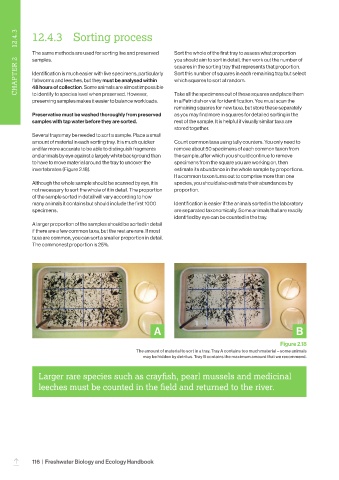
            Several trays may be needed to sort a sample. Place a small
            amount of material in each sorting tray. It is much quicker   Count common taxa using tally counters. You only need to
            and far more accurate to be able to distinguish fragments   remove about 50 specimens of each common taxon from
            and animals by eye against a largely white background than   the sample, after which you should continue to remove
            to have to move material around the tray to uncover the   specimens from the square you are working on, then
            invertebrates (Figure 2.18).                      estimate its abundance in the whole sample by proportions.
                                                              If a common taxon turns out to comprise more than one
            Although the whole sample should be scanned by eye, it is   species, you should also estimate their abundances by
            not necessary to sort the whole of it in detail. The proportion   proportion.
            of the sample sorted in detail will vary according to how
            many animals it contains but should include the first 1000   Identification is easier if the animals sorted in the laboratory
            specimens.                                        are separated taxonomically. Some animals that are readily
                                                              identified by eye can be counted in the tray.
            A larger proportion of the samples should be sorted in detail
            if there are a few common taxa, but the rest are rare. If most
            taxa are common, you can sort a smaller proportion in detail.
            The commonest proportion is 25%.


                                                       A                                                 B


                                                                                                   Figure 2.18
                                                 The amount of material to sort in a tray. Tray A contains too much material – some animals
                                                   may be hidden by detritus. Tray B contains the maximum amount that we recommend.

               Larger rare species such as crayfish, pearl mussels and medicinal

               leeches must be counted in the field and returned to the river.


            116  |  Freshwater Biology and Ecology Handbook
      –

