


Page 122 - Freshwater-Biology-and-Ecology-Handbook
P. 122
CHAPTER 2     13                           13


                QUALITY ASSURANCE OF LABORATORY

                   ANALYSIS AND DATA HANDLING AND

                              DATA QUALITY STANDARDS


            Error is inevitable in ecological survey data, but it can   (including the UK River Communities team). STAR/AQEM
            be minimised, and also measured by numerical quality   samples were collected according to the method described
            assurance procedures so that it can be considered in data   in Section 15 and national samples were collected by a
            analysis and interpretation. Measuring errors ensures that   variety of methods according to different national protocols
            data is interpreted correctly by enabling real ecological   used in 2002. The results showed the considerable range
            differences to be distinguished from those caused by error.  in quality that is typical of laboratories that have not been
                                                              audited before, and therefore their analysts are unaware
            Clear, unambiguous and comprehensive instructions are   of what they are missing. Experience from the UK audit
            an essential step in quality assurance. The Environment   showed that most errors stem from not noticing the
            Agency has produced a series of Operational Instructions   presence of specimens in the sorting tray rather than from
            that cover almost every aspect of its work. Those relevant to   misidentifications. It also showed that quality tends to vary
            invertebrate sampling and analysis are mentioned here.  much more between laboratories than within them. As a
                                                              result, the UK’s environment protection agencies audited
            Unless an error is highlighted, it is often impossible for an   each of their laboratories by having 20 random samples
            individual to know that they are making mistakes. Active   re-analysed from each laboratory each year.
            feedback is at the core of quality assurance procedures.

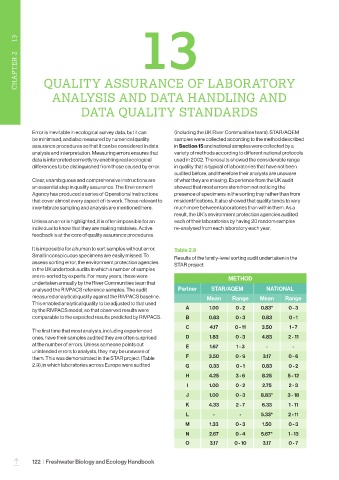
            It is impossible for a human to sort samples without error.   Table 2.9
            Small inconspicuous specimens are easily missed. To   Results of the family-level sorting audit undertaken in the
            assess sorting error, the environment protection agencies   STAR project
            in the UK undertook audits in which a number of samples
            are re-sorted by experts. For many years, these were                 METHOD
            undertaken annually by the River Communities team that
            analysed the RIVPACS reference samples. The audit   Partner    STAR/AQEM           NATIONAL
            measured analytical quality against the RIVPACS baseline.     Mean     Range    Mean     Range
            This enabled analytical quality to be adjusted to that used
            by the RIVPACS model, so that observed results were   A        1.00     0 - 2    0.83*    0 - 3
            comparable to the expected results predicted by RIVPACS.  B   0.83      0 - 3    0.83      0 - 1
                                                                  C        4.17     0 - 11   3.50      1 - 7
            The first time that most analysts, including experienced
            ones, have their samples audited they are often surprised   D  1.83     0 - 3    4.83     2 - 11
            at the number of errors. Unless someone points out    E        1.67     1 - 3     -         -
            unintended errors to analysts, they may be unaware of
            them. This was demonstrated in the STAR project (Table   F    3.50      0 - 9    3.17     0 - 6
            2.9), in which laboratories across Europe were audited   G    0.33      0 - 1    0.83     0 - 2

                                                                  H       4.25      3 - 6    8.25     5 - 12
                                                                   I      1.00      0 - 2    2.75     2 - 3
                                                                  J       1.00      0 - 3    8.83*    3 - 18
                                                                  K       4.33      2 - 7    6.33     1 - 11
                                                                  L         -        -       5.33*    2 - 11
                                                                  M        1.33     0 - 3    1.50     0 - 3
                                                                  N       2.67      0 - 4    5.67*    1 - 13
                                                                  O        3.17    0 - 10    3.17     0 - 7


            122  |  Freshwater Biology and Ecology Handbook
      –

