


Page 123 - Freshwater-Biology-and-Ecology-Handbook
P. 123
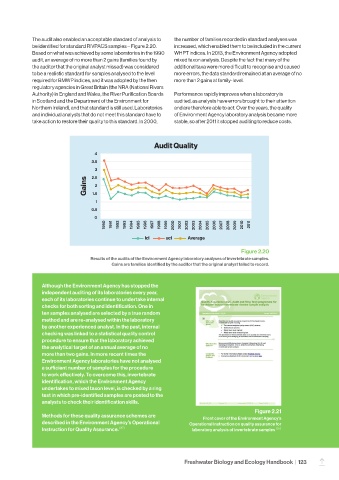
The audit also enabled an acceptable standard of analysis to   the number of families recorded in standard analyses was
            be identified for standard RIVPACS samples – Figure 2.20.   increased, which enabled them to be included in the current
            Based on what was achieved by some laboratories in the 1990   WHPT indices. In 2013, the Environment Agency adopted
            audit, an average of no more than 2 gains (families found by   mixed taxon analysis. Despite the fact that many of the
            the auditor that the original analyst missed) was considered   additional taxa were more difficult to recognise and caused
            to be a realistic standard for samples analysed to the level   more errors, the data standard remained at an average of no
            required for BMWP indices, and it was adopted by the then   more than 2 gains at family-level.
            regulatory agencies in Great Britain (the NRA (National Rivers
            Authority) in England and Wales, the River Purification Boards   Performance rapidly improves when a laboratory is
            in Scotland and the Department of the Environment for   audited, as analysts have errors brought to their attention
            Northern Ireland), and that standard is still used. Laboratories   and are therefore able to act. Over the years, the quality
            and individual analysts that do not meet this standard have to   of Environment Agency laboratory analysis became more
            take action to restore their quality to this standard. In 2000,   stable, so after 2011 it stopped auditing to reduce costs.


                                                       Audit Quality
                                  4
                                 3.5
                                  3
                                 2.5
                               Gains  1.5 2


                                   1
                                 0.5
                                  0
                                      1990  1991  1992  1993  1994  1995  1996  1997  1998  1999  2000  2001  2002  2003  2004  2005  2006  2007  2008  2009  2010  2011


                                                    lcl    ucl     Average
                                                                                      Figure 2.20
                                 Results of the audits of the Environment Agency laboratory analyses of invertebrate samples.
                                        Gains are families identified by the auditor that the original analyst failed to record.


                Although the Environment Agency has stopped the
                independent auditing of its laboratories every year,
                each of its laboratories continue to undertake internal
                checks for both sorting and identification. One in
                ten samples analysed are selected by a true random
                method and are re-analysed within the laboratory
                by another experienced analyst. In the past, internal
                checking was linked to a statistical quality control
                procedure to ensure that the laboratory achieved
                the analytical target of an annual average of no
                more than two gains. In more recent times the
                Environment Agency laboratories have not analysed
                a sufficient number of samples for the procedure
                to work effectively. To overcome this, invertebrate
                identification, which the Environment Agency
                undertakes to mixed taxon level, is checked by a ring
                test in which pre-identified samples are posted to the
                analysts to check their identification skills.
                                                                                          Figure 2.21
                Methods for these quality assurance schemes are         Front cover of the Environment Agency’s
                described in the Environment Agency’s Operational   Operational Instruction on quality assurance for
                Instruction for Quality Assurance.  (37)            laboratory analysis of invertebrate samples  (37)


                                                                  Freshwater Biology and Ecology Handbook  |  123
                                                                                                                 –

