


Page 129 - Freshwater-Biology-and-Ecology-Handbook
P. 129
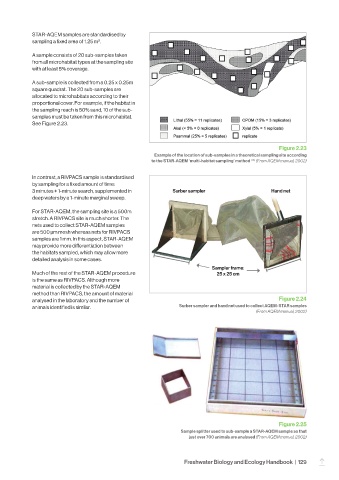
STAR-AQEM samples are standardised by
            sampling a fixed area of 1.25 m2.

            A sample consists of 20 sub-samples taken
            from all microhabitat types at the sampling site
            with at least 5% coverage.

            A sub-sample is collected from a 0.25 x 0.25m
            square quadrat. The 20 sub-samples are
            allocated to microhabitats according to their
            proportional cover. For example, if the habitat in
            the sampling reach is 50% sand, 10 of the sub-
            samples must be taken from this microhabitat.
            See Figure 2.23.


                                                                                                   Figure 2.23
                                                       Example of the location of sub-samples in a theoretical sampling site according
                                                      to the STAR-AQEM ‘multi-habitat sampling’ method   (From AQEM manual, 2002)
                                                                                         (16)
            In contrast, a RIVPACS sample is standardised
            by sampling for a fixed amount of time:
            3 minutes + 1-minute search, supplemented in      Surber sampler                    Hand net
            deep waters by a 1-minute marginal sweep.

            For STAR-AQEM, the sampling site is a 500m
            stretch. A RIVPACS site is much shorter. The
            nets used to collect STAR-AQEM samples
            are 500 μm mesh whereas nets for RIVPACS
            samples are 1 mm. In this aspect, STAR-AQEM
            may provide more differentiation between
            the habitats sampled, which may allow more
            detailed analysis in some cases.
                                                                           Sampler frame:
            Much of the rest of the STAR-AQEM procedure                      25 x 25 cm
            is the same as RIVPACS. Although more
            material is collected by the STAR-AQEM
            method than RIVPACS, the amount of material
            analysed in the laboratory and the number of                                           Figure 2.24
            animals identified is similar.                      Surber sampler and hand net used to collect AQEM-STAR samples
                                                                                           (From AQEM manual, 2002)


                                                                                                   Figure 2.25
                                                                 Sample splitter used to sub-sample a STAR-AQEM sample so that
                                                                   just over 700 animals are analysed (From AQEM manual, 2002)


                                                                  Freshwater Biology and Ecology Handbook  |  129
                                                                                                                 –

