


Page 128 - Freshwater-Biology-and-Ecology-Handbook
P. 128
CHAPTER 2     15                           15


                                   STAR-AQEM SAMPLING

                      METHODOLOGIES AND SYNERGIES

                                               TO RIVPACS


            RIVPACS and STAR-AQEM are the two methods most
            widely used across Europe for sampling and analysing river
            invertebrates for the Water Framework Directive. They share
            fundamental principles of pro rata multi-habitat sampling.
            The STAR-AQEM method is used mainly in central Europe.
            We have included it in this book for the benefit of readers who
            are standardising methods in their own countries. In Europe,
            we recommend using either RIVPACS or STAR-AQEM,
            depending on which is used in neighbouring states, especially
            those sharing transboundary rivers and therefore sharing the
            same River Basin Management Plans. This will ensure that data
            is comparable beyond intercalibration, not only for analysis
            and reporting, but also for sharing data from reference sites.
            STAR-AQEM sampling is described in the current European
            (CEN) standard (EN 16150:2012. Water Quality – Guidance on
            pro-rata multi-habitat sampling of benthic macro-invertebrates
            from wadeable rivers).  (38)

            Like RIVPACS, STAR-AQEM sampling is pro rata multi-habitat,
            in which all habitats at the site are sampled in proportion to their
            cover.  (39)  This approach provides a consistent method that can
            be used in all types of river, providing comparable samples for
            classification and assessment, whatever habitats are available.

            A manual describing STAR-AQEM is available from the STAR
            website http://www.eu-star.at/, by following the path: enter >
            protocols > AQEM macro-invertebrate sampling protocol.
            The original, detailed method is described on the AQEM
            website.   The AQEM manual (http://www.aqem.de/mains/
                   (16)
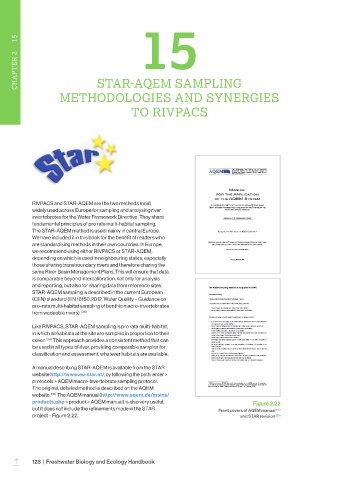
            products.php > product > AQEM manual) is also very useful,                    Figure 2.22
            but it does not include the refinements made in the STAR          Front covers of AQEM manual
                                                                                                  (16)
            project – Figure 2.22.                                                   and STAR revision  (39)


            128  |  Freshwater Biology and Ecology Handbook
      –

