


Page 21 - Freshwater-Biology-and-Ecology-Handbook
P. 21
In the past we have managed freshwater using only chemical assessments linked to pollution from
               industrial and municipal discharges to the water environment.

               Being able to assess water ecosystem health has been the result of significant research and
               development over the past 100 years or so.

               This was connected to progressive water environmental legislation, regulation and enforcement.


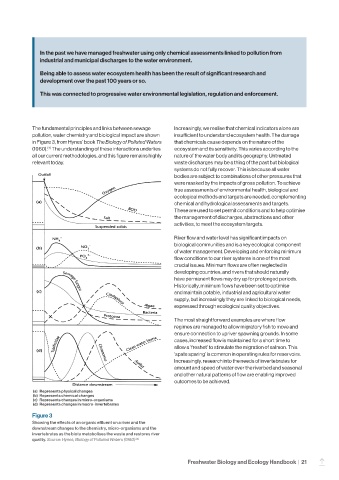
            The fundamental principles and links between sewage   Increasingly, we realise that chemical indicators alone are
            pollution, water chemistry and biological impact are shown   insufficient to understand ecosystem health. The damage
            in Figure 3, from Hynes’ book The Biology of Polluted Waters   that chemicals cause depends on the nature of the
            (1960).  The understanding of these interactions underlies   ecosystem and its sensitivity. This varies according to the
                  (4)
            all our current methodologies, and this figure remains highly   nature of the water body and its geography. Untreated
            relevant today.                                   waste discharges may be a thing of the past but biological
                                                              systems do not fully recover. This is because all water
                                                              bodies are subject to combinations of other pressures that
                                                              were masked by the impacts of gross pollution. To achieve
                                                              true assessments of environmental health, biological and
                                                              ecological methods and targets are needed, complementing
                                                              chemical and hydrological assessments and targets.
                                                              These are used to set permit conditions and to help optimise
                                                              the management of discharges, abstractions and other
                                                              activities, to meet the ecosystem targets.


                                                              River flow and water level has significant impacts on
                                                              biological communities and is a key ecological component
                                                              of water management. Developing and enforcing minimum
                                                              flow conditions to our river systems is one of the most
                                                              crucial issues. Minimum flows are often neglected in
                                                              developing countries, and rivers that should naturally
                                                              have permanent flows may dry up for prolonged periods.
                                                              Historically, minimum flows have been set to optimise
                                                              and maintain potable, industrial and agricultural water
                                                              supply, but increasingly they are linked to biological needs,
                                                              expressed through ecological quality objectives.


                                                              The most straightforward examples are where flow
                                                              regimes are managed to allow migratory fish to move and
                                                              ensure connection to upriver spawning grounds. In some
                                                              cases, increased flow is maintained for a short time to
                                                              allow a ‘freshet’ to stimulate the migration of salmon. This
                                                              ‘spate sparing’ is common in operating rules for reservoirs.
                                                              Increasingly, research into the needs of invertebrates for
                                                              amount and speed of water over the riverbed and seasonal
                                                              and other natural patterns of flow are enabling improved
                                                              outcomes to be achieved.
             (a)  Represents physical changes
             (b)  Represents chemical changes
             (c)  Represents changes in micro-organisms
             (d)  Represents changes in macro-invertebrates
            Figure 3
            Showing the effects of an organic effluent on a river and the
            downstream changes to the chemistry, micro-organisms and the
            invertebrates as the biota metabolises the waste and restores river
            quality. Source: Hynes, Biology of Polluted Waters (1960)  (4)


                                                                   Freshwater Biology and Ecology Handbook  |  21
                                                                                                                 –

