


Page 226 - Freshwater-Biology-and-Ecology-Handbook
P. 226
CHAPTER 5     3.1.6 – 3.1.7  Organic loading and hence its breakdown (saprobity)   matter, the saprobic scale is intimately related to the


            in surface waters can be generated by autotrophic
                                                              eutrophic scale and therefore to the chemical indicators
            production by aquatic plants and algae – a process known
                                                              of eutrophication, though the concentrations vary
                                                              between different types of surface waters, hence differing
            as autosaprobity – and the input of allochthonous organic
                                                              nutrient standards in rivers and lakes. However, this direct
            matter from leaves, run-off and waste discharges is
            termed allosaprobity. Because nitrogen and phosphorus
                                                              relationship is sometimes forgotten, and nutrient standards
            compounds are released by the breakdown of organic
                                                              can be misaligned to standards for organic loading.
            Table 5. 2
            The relationship between indicators of saprobity and eutrophy (Wegl 1983)  (81)

                                                                 Total P  Chlorophyll-a  Summer   Biomass  Total N
                                  Index
                                                 O2
             Saprobity     BOD5          NH4          Trophy      (mg/               Secchi
                           (mg/l)  Value  (mg/l) (mg/l)                   (mg/m )            (mg/m ) (mg/m )
                                                                               3
                                                                                                  3
                                                                                                           3
                                                                    3
                                                                  m )                 (m)
             Oligosaprobic   <1     1     <0.1   >8   Oligotrophy  <13      <3         >5     <2,000   <300
             β-mesosaprobic  <5     2     <0.5   >6   Mesotrophy  <40       <10        5–1    <7,000   <400
             α-mesosaprobic  <13    3     <13    >2   Eutrophy    <100      <40       1–0.5  <10,000  <1,000
             Polysaprobic   >20     4     >20    <1   Hypertrophy  >100     >40       <0.5   >10,000  >1,000


                                           The official Austrian river invertebrate status classification based on saprobic
                                           indices follows ÖNORM M6232, and is calculated using ECOPROF version 5.0
                                           software, available since February 2019 at:
                                           https://www.ecoprof.at/index.php/Allgemeines.html


                                           The official German river invertebrate status classification based on saprobic
                                           indices following DIN 38 410, uses the Deutscher Saprobienindex (neue Version),
                                           which can be calculated using desktop ASTERICS Version 4.0.4 or the online
                                           PERLODES software, available from:
                                           https://www.gewaesser-bewertung-berechnung.de/index.php/home.html


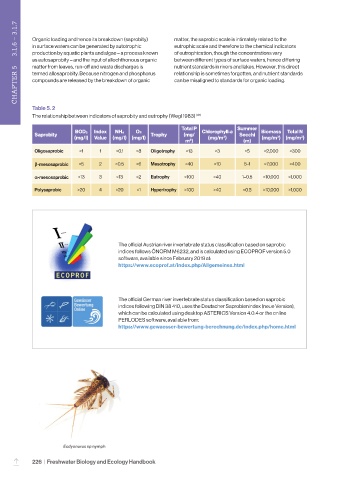
                       Ecdyonurus sp nymph

            226  |  Freshwater Biology and Ecology Handbook
      –

