


Page 231 - Freshwater-Biology-and-Ecology-Handbook
P. 231
3.1.11   MIS-index


            (Monitoring Intermittent
            Streams index)


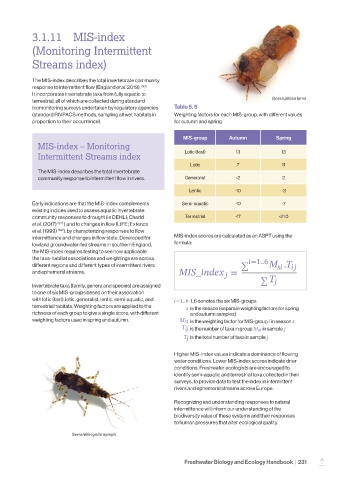
            The MIS-index describes the total invertebrate community
            response to intermittent flow (England et al. 2019).  (93)
            It incorporates invertebrate taxa from fully aquatic to
            terrestrial, all of which are collected during standard                              Goera pilosa larva
            biomonitoring surveys undertaken by regulatory agencies   Table 5. 5
            (standard RIVPACS methods, sampling all wet habitats in   Weighting factors for each MIS-group, with different values
            proportion to their occurrence).                  for autumn and spring


                                                                 MIS-group       Autumn           Spring
              MIS-index – Monitoring
              Intermittent Streams index                          Lotic (fast)      13              13

                                                                    Lotic           7               11
              The MIS-index describes the total invertebrate
              community response to intermittent flow in rivers.  Generalist        -2              2

                                                                   Lentic           -10             -3

            Early indications are that the MIS-index complements   Semi-aquatic     -10             -7
            existing indices used to assess aquatic invertebrate
            community responses to drought (ie DEHLI; Chadd       Terrestrial       -17            -21.0
            et al. (2017)  (92)  ) and to changes in flow (LIFE; Extence
            et al. (1999)  (89) ), by characterizing responses to flow
            intermittence and changes in flow state. Developed for   MIS-index scores are calculated as an ASPT using the
            lowland groundwater-fed streams in southern England,   formula:
            the MIS-index requires testing to see how applicable
            the taxa-habitat associations and weightings are across
            different regions and different types of intermittent rivers
            and ephemeral streams.

            Invertebrate taxa (family, genera and species) are assigned
            to one of six MIS-groups based on their association
            with lotic (fast), lotic, generalist, lentic, semi-aquatic, and   1..6 denotes the six MIS-groups
            terrestrial habitats. Weighting factors are applied to the   is the season (separate weighting factors for spring
            richness of each group to give a single score, with different   and autumn samples)
            weighting factors used in spring and autumn.            is the weighting factor for MIS-group    in season
                                                                    is the number of taxa in group            in sample
                                                                    is the total number of taxa in sample


                                                              Higher MIS-index values indicate a dominance of flowing
                                                              water conditions. Lower MIS-index scores indicate drier
                                                              conditions. Freshwater ecologists are encouraged to
                                                              identify semi-aquatic and terrestrial taxa collected in their
                                                              surveys, to provide data to test the index in intermittent
                                                              rivers and ephemeral streams across Europe.


                                                              Recognizing and understanding responses to natural
                                                              intermittence will inform our understanding of the
                                                              biodiversity value of these systems and their responses
                                                              to human pressures that alter ecological quality.

                          Serratella ignita nymph


                                                                  Freshwater Biology and Ecology Handbook  |  231
                                                                                                                 –

