


Page 229 - Freshwater-Biology-and-Ecology-Handbook
P. 229
3.1.9  LIFE (Lotic-invertebrate Index for Flow Evaluation)


            The Lotic-invertebrate Index for Flow Evaluation was   Different index values (flow scores) are given to each taxon
            developed by Chris Extence and his colleagues in Anglian   depending on its flow group and abundance and the index
            Region of the Environment Agency to assess the potential   is expressed as an average (flow score) per taxon. LIFE
            impact of flow-related stresses on river invertebrate   uses the same log  abundance categories as RIVPACS,
                                                                            10
            communities (Extence et al. 1999).  (89)  LIFE is used by the   but designated A–E rather than 1–5 to avoid confusion
            Environment Agency for Hydroecological Validation (HEV)   with Flow Groups. LIFE should only be calculated from
            to help manage water resources.                   standard RIVPACS samples (described in Chapter 2).

                                                              LIFE has been incorporated in RIVPACS (Clarke et al.
               LIFE – Lotic-invertebrate Index                2003)  (90)  so that it can be standardised across river
               for Flow Evaluation                            types as O/E ratios. This is the form in which it is used for
                                                              Hydroecological Validation (see Section 3.2.5). LIFE can
                                                              vary between seasons, so spring and autumn samples are
               LIFE index relates to the flow velocity preferences of   analysed independently, and impact is generally based on
               invertebrates and is used to evaluate flow pressures.  the season indicating poorest quality.

                                                              A LIFE index has been developed for New Zealand
            Each species or family is assigned to one of six flow   (Greenwood et al. 2016)  (91)  using the same principles as
            groups according to their perceived association with   the UK version.
            different flow conditions, although many taxa can be found
            in a range of habitats and flow types (Table 5.4). LIFE can
            be calculated for families LIFE(F) or for species LIFE(S).
            LIFE includes some estuarine families that are not found in
            purely freshwaters because saline intrusion is a common
            effect of reduced flows in the most downstream reaches of
            watercourses.


            Table 5. 4
            Flow associations used in LIFE

                 Group             Primary flow association       Typical mean current velocity

                   I                      Rapid                          >100 cm.s  -1

                   II                  Moderate to fast                  20–100 cm.s -1

                   III                 Slow to sluggish                   < 20 cm.s -1

                   IV         Flowing (usually slow) and standing waters

                   V                   Standing waters
                   VI            Drying or drought-impacted sites


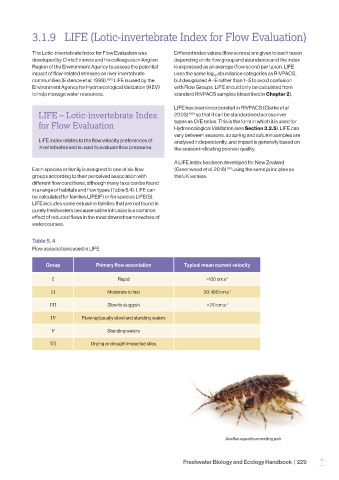
                                                                                Asellus aquaticus mating pair


                                                                 Freshwater Biology and Ecology Handbook  |  229
                                                                                                                 –

