


Page 29 - Freshwater-Biology-and-Ecology-Handbook
P. 29
The WFD introduces ecological objectives to the heart of   Information to determine these pressures and risks is
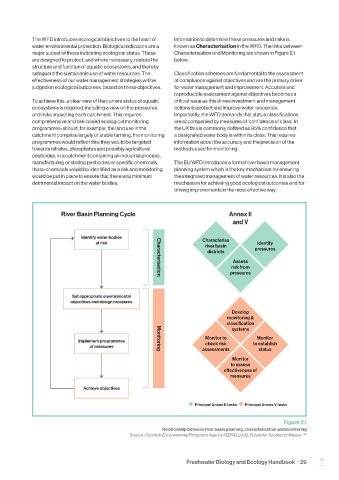
            water environmental protection. Biological indicators are a   known as Characterisation in the WFD. The links between
            major subset of those indicating ecological status. These   Characterisation and Monitoring are shown in Figure 2.1
            are designed to protect, and where necessary, restore the   below.
            structure and function of aquatic ecosystems, and thereby
            safeguard the sustainable use of water resources. The   Classification schemes are fundamental to the assessment
            effectiveness of our water management strategies will be   of compliance against objectives and are the primary driver
            judged on ecological outcomes, based on these objectives.  for water management and improvement. Accurate and
                                                              reproducible assessment against objectives becomes a
            To achieve this, a clear view of the current status of aquatic   critical issue as this drives investment and management
            ecosystems is required, including a view on the pressures   actions to protect and improve water resources.
            and risks impacting each catchment. This requires   Importantly, the WFD demands that status classifications
            comprehensive and risk-based ecological monitoring   are accompanied by measures of ‘confidence of class’. In
            programmes: should, for example, the land use in the   the UK this is commonly defined as 95% confidence that
            catchment comprise largely of arable farming, the monitoring   a designated water body is within its class. This requires
            programmes would reflect this; they would be targeted   information about the accuracy and the precision of the
            towards nitrates, phosphates and possibly agricultural   methods used for monitoring.
            pesticides. In a catchment containing an industrial process,
            manufacturing or storing pesticides or specific chemicals,   The EU WFD introduces a formal river basin management
            those chemicals would be identified as a risk and monitoring   planning system which is the key mechanism for ensuring
            would be put in place to ensure that there was minimum   the integrated management of water resources. It is also the
            detrimental impact on the water bodies.           mechanism for achieving good ecological outcomes and for
                                                              driving improvements in the most effective way.


                       River Basin Planning Cycle                                 Annex II
                                                                                   and V


                              Identify water bodies                     Characterise
                                   at risk                                                 Identify
                                                                         river basin      pressures
                                                                          districts
                                                                                   Assess
                                                                                  risk from
                                                                                  pressures
                                                        Characterisation

                          Set appropriate environmental
                          objectives and design measures
                                                                                  Develop
                                                                                 monitoring &
                                                                                 classification
                                                                                  systems
                                                                         Monitor to        Monitor
                             Implement programmes                        check risk       to establish
                                 of measures
                                                                        assessments         status
                                                        Monitoring
                                                                                   Monitor
                                                                                  to assess
                                                                                effectiveness of
                                                                                  measures
                              Achieve objectives


                                                                       Principal Annex II tasks      Principal Annex V tasks


                                                                                                     Figure 2.1
                                                          Relationship between river basin planning, characterisation and monitoring
                                               Source - Scottish Environmental Protection Agency (SEPA), 2002, Future for Scotland’s Waters.  (12)


                                                                  Freshwater Biology and Ecology Handbook  |  29
                                                                                                                 –

