


Page 37 - Freshwater-Biology-and-Ecology-Handbook
P. 37
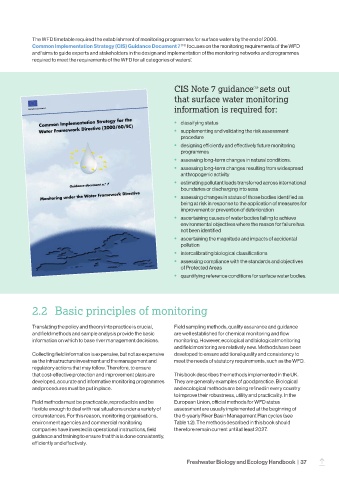
The WFD timetable required the establishment of monitoring programmes for surface waters by the end of 2006.
                                                                 (13)
            Common Implementation Strategy (CIS) Guidance Document 7   focuses on the monitoring requirements of the WFD
            and ‘aims to guide experts and stakeholders in the design and implementation of the monitoring networks and programmes
            required to meet the requirements of the WFD for all categories of waters'.


                                                              CIS Note 7 guidance  sets out
                                                                                          (13)
                                                              that surface water monitoring

                                                              information is required for:

                                                              •  classifying status
                                                              •  supplementing and validating the risk assessment
                                                                procedure
                                                              •  designing efficiently and effectively future monitoring
                                                                programmes
                                                              •  assessing long-term changes in natural conditions.
                                                              •  assessing long-term changes resulting from widespread
                                                                anthropogenic activity
                                                              •  estimating pollutant loads transferred across international
                                                                boundaries or discharging into seas
                                                              •  assessing changes in status of those bodies identified as
                                                                being at risk in response to the application of measures for
                                                                improvement or prevention of deterioration
                                                              •  ascertaining causes of water bodies failing to achieve
                                                                environmental objectives where the reason for failure has
                                                                not been identified
                                                              •  ascertaining the magnitude and impacts of accidental
                                                                pollution
                                                              •  intercalibrating biological classifications
                                                              •  assessing compliance with the standards and objectives
                                                                of Protected Areas
                                                              •  quantifying reference conditions for surface water bodies.


            2.2  Basic principles of monitoring


            Translating the policy and theory into practice is crucial,   Field sampling methods, quality assurance and guidance
            and field methods and sample analysis provide the basic   are well established for chemical monitoring and flow
            information on which to base river management decisions.  monitoring. However, ecological and biological monitoring
                                                              and field monitoring are relatively new. Methods have been
            Collecting field information is expensive, but not as expensive   developed to ensure additional quality and consistency to
            as the infrastructure investment and the management and   meet the needs of statutory requirements, such as the WFD.
            regulatory actions that may follow. Therefore, to ensure
            that cost-effective protection and improvement plans are   This book describes the methods implemented in the UK.
            developed, accurate and informative monitoring programmes   They are generally examples of good practice. Biological
            and procedures must be put in place.              and ecological methods are being refined in every country
                                                              to improve their robustness, utility and practicality. In the
            Field methods must be practicable, reproducible and be   European Union, official methods for WFD status
            flexible enough to deal with real situations under a variety of   assessment are usually implemented at the beginning of
            circumstances. For this reason, monitoring organisations,   the 6-yearly River Basin Management Plan cycles (see
            environment agencies and commercial monitoring    Table 1.2). The methods described in this book should
            companies have invested in operational instructions, field   therefore remain current until at least 2027.
            guidance and training to ensure that this is done consistently,
            efficiently and effectively.


                                                                   Freshwater Biology and Ecology Handbook  |  37
                                                                                                                 –

