


Page 41 - Freshwater-Biology-and-Ecology-Handbook
P. 41
The Directive also requires that the monitoring frequencies   The Directive also points out that the times at which
            take account of the variability of parameters resulting from   monitoring is undertaken must minimise the impact of
            natural and anthropogenic conditions.             seasonal variation so that the results reflect changes only
                                                              as a result of anthropogenic pressure. Additional monitoring
            Ultimately, the frequencies should allow for an acceptable   during different seasons may be necessary to achieve this
            level of confidence and precision, which must be stated in   objective. However, samples for the same element must
            the River Basin Management Plan.                  always be collected in the same seasons to avoid natural
                                                              seasonal effects from influencing the monitoring results.
            Low confidence and precision can cause changes of class
            that are not easily explained, as well as making it more   In the temperate northern hemisphere climates of Europe
            difficult to justify more expensive programmes of measures   and the UK, the normal default frequencies are presented in
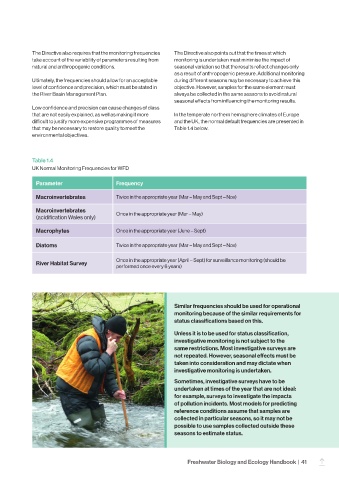
            that may be necessary to restore quality to meet the   Table 1.4 below.
            environmental objectives.


            Table 1.4
            UK Normal Monitoring Frequencies for WFD


              Parameter                   Frequency
              Macroinvertebrates          Twice in the appropriate year (Mar – May and Sept – Nov)

              Macroinvertebrates
              (acidification Wales only)  Once in the appropriate year (Mar – May)

              Macrophytes                 Once in the appropriate year (June – Sept)

              Diatoms                     Twice in the appropriate year (Mar – May and Sept – Nov)

                                          Once in the appropriate year (April – Sept) for surveillance monitoring (should be
              River Habitat Survey
                                          performed once every 6 years)


                                                              Similar frequencies should be used for operational
                                                              monitoring because of the similar requirements for
                                                              status classifications based on this.
                                                              Unless it is to be used for status classification,
                                                              investigative monitoring is not subject to the
                                                              same restrictions. Most investigative surveys are
                                                              not repeated. However, seasonal effects must be
                                                              taken into consideration and may dictate when
                                                              investigative monitoring is undertaken.

                                                              Sometimes, investigative surveys have to be
                                                              undertaken at times of the year that are not ideal:
                                                              for example, surveys to investigate the impacts
                                                              of pollution incidents. Most models for predicting
                                                              reference conditions assume that samples are
                                                              collected in particular seasons, so it may not be
                                                              possible to use samples collected outside these
                                                              seasons to estimate status.


                                                                   Freshwater Biology and Ecology Handbook  |  41
                                                                                                                 –

