


Page 139 - Freshwater-Biology-and-Ecology-Handbook
P. 139
Other evidence                                    Other evidence


                                                        Reporting


                              Data analysis
                              Data analysis                                        Data
                              biotic indices
                              biotic indices                                     analysis &
                                & status                                         diagnosis
                                & status
                              classification
                              classification
                                              Compliance
               Laboratory                        with            Programme                      Laboratory
                analysis     Surveillance      objectives        of measures                     analysis
                                  and          PASS  FAIL                      Investigative
                              operational                                       monitoring
                              monitoring


                        Field                                                                Field
                     monitoring                                                           monitoring
                      and data            Review                         Review            and data
                      collection                                                           collection


                       WFD status classification                            Non-classification


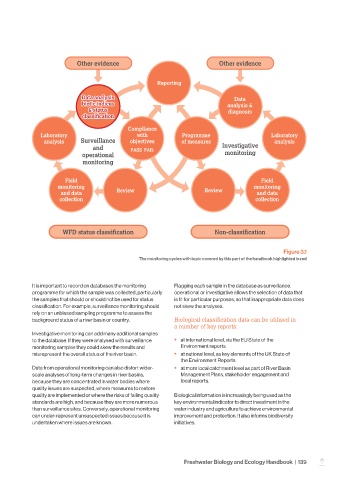
                                                                                                     Figure 3.1
                                                  The monitoring cycles with topic covered by this part of the handbook highlighted in red


            It is important to record on databases the monitoring   Flagging each sample in the database as surveillance,
            programme for which the sample was collected, particularly   operational or investigative allows the selection of data that
            the samples that should or should not be used for status   is fit for particular purposes, so that inappropriate data does
            classification. For example, surveillance monitoring should   not skew the analyses.
            rely on an unbiased sampling programme to assess the
            background status of a river basin or country.    Biological classification data can be utilised in
                                                              a number of key reports:
            Investigative monitoring can add many additional samples
            to the database. If they were analysed with surveillance   •  at international level, via the EU State of the
            monitoring samples they could skew the results and   Environment reports
            misrepresent the overall status of the river basin.   •  at national level, as key elements of the UK State of
                                                                the Environment Reports
            Data from operational monitoring can also distort wider-  •  at more local catchment level as part of River Basin
            scale analyses of long-term changes in river basins,   Management Plans, stakeholder engagement and
            because they are concentrated in water bodies where   local reports.
            quality issues are suspected, where measures to restore
            quality are implemented or where the risks of failing quality   Biological information is increasingly being used as the
            standards are high, and because they are more numerous   key environmental indicator to direct investment in the
            than surveillance sites. Conversely, operational monitoring   water industry and agriculture to achieve environmental
            can under-represent unsuspected issues because it is   improvement and protection. It also informs biodiversity
            undertaken where issues are known.                initiatives.


                                                                  Freshwater Biology and Ecology Handbook  |  139
                                                                                                                 –

