


Page 141 - Freshwater-Biology-and-Ecology-Handbook
P. 141
Ballinderry River             Black Burn
                                    Ballinder r y River
                                                                                              Cru mlin River
                                                COOKSTOWN
                                                                          LOUGH NEAGH
                                          Killymoon River
                                 Pomeroy
                                               STEWARTSTOWN


                                 Cappagh
                                                      COALISLAND
                                                                                         Aghalee
                                       Donaghmore
                                                 River Torrent
                                               DUNGANNON
                                   Castlecaufield
                                            MOYGASHEL                                         MOIRA
                      lygowley Water             River Rhone           CRAIGAVON            Magheralin
                        Ballygawley                                                    LURGAN
                                       Oona Water  Eglish
                                                   Moy        River Tall
                                                                                         Waringstown
                                                                 PORTADOWN
                                                                             River Ban n
                                                  Blackwatertown
                             AUGHNACLOY
                                                                        Ballybay River  Lawrencetown
                                                             Loughgall
                                             River Blackwater
                                                                                    GILFORD
                                                               Richhill
                                                                                            BANBRID
                                     Caledon    ARMAGH                         TANDRAGEE
                                                  GOOD               (Unstressed Fauna)
                                                  MODERATE           (Slightly Stressed Fauna)
                                                  POOR               (Highly Stressed Fauna)

                                                  BAD                (Extremely Stressed Fauna)

                                                  NOT CLASSIFIED


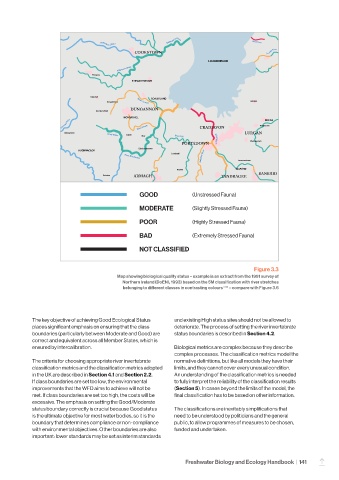
                                                                                          Figure 3.3
                                          Map showing biological quality status – example is an extract from the 1991 survey of

                                            Northern Ireland(DoENI, 1993) based on the 5M classification with river stretches
                                            belonging to different classes in contrasting colours  (40)  – compare with Figure 3.6


            The key objective of achieving Good Ecological Status   and existing High status sites should not be allowed to
            places significant emphasis on ensuring that the class   deteriorate. The process of setting the river invertebrate
            boundaries (particularly between Moderate and Good) are   status boundaries is described in Section 4.2.
            correct and equivalent across all Member States, which is
            ensured by intercalibration.                      Biological metrics are complex because they describe
                                                              complex processes. The classification metrics model the
            The criteria for choosing appropriate river invertebrate   normative definitions, but like all models they have their
            classification metrics and the classification metrics adopted   limits, and they cannot cover every unusual condition.
            in the UK are described in Section 4.1 and Section 2.2.   An understanding of the classification metrics is needed
            If class boundaries are set too low, the environmental   to fully interpret the reliability of the classification results
            improvements that the WFD aims to achieve will not be   (Section 5). In cases beyond the limits of the model, the
            met. If class boundaries are set too high, the costs will be   final classification has to be based on other information.
            excessive. The emphasis on setting the Good/Moderate
            status boundary correctly is crucial because Good status   The classifications are inevitably simplifications that
            is the ultimate objective for most water bodies, so it is the   need to be understood by politicians and the general
            boundary that determines compliance or non-compliance   public, to allow programmes of measures to be chosen,
            with environmental objectives. Other boundaries are also   funded and undertaken.
            important: lower standards may be set as interim standards


                                                                  Freshwater Biology and Ecology Handbook  |  141
                                                                                                                 –

