


Page 144 - Freshwater-Biology-and-Ecology-Handbook
P. 144
CHAPTER 3     2.2  2.2  WHPT (Walley Hawkes Paisley Trigg) indices

            WHPT was developed as a more accurate and more precise
                                                              on expert judgement based on the limited knowledge that
                                                              was available in the late 1970s. WHPT makes use of more
            replacement for BMWP for operational and surveillance
                                                              taxa than BMWP by using data from additional families
            assessment and status classification, made possible
                                                              included in monitoring from about the year 2000.
            because of data available from monitoring between 1990
            and 2005. Better accuracy and precision were needed
            because of the subtle but critical difference between
                                                              ability to detect moderate changes in invertebrate quality
            Moderate and Good status, which is the boundary between   The inclusion of abundance data improved the index’s
            achieving and failing environmental quality objectives for   associated with eutrophication, and it also improved
            most water bodies.                                compliance with the WFD’s normative definitions. When
                                                              deriving WHPT index values, different abundances of the
            The derivation of WHPT values from BMWP ASPT is   same taxon were analysed as if they were different taxa.
            described in Paisley et al. (2014).   WHPT indices replaced   For most taxa, there is a different value of WHPT for each
                                     (41)
            BMWP indices in time for the UK’s second River Basin   RIVPACS abundance category (Table 3.1 & Table 3.2).
            Management Plans, published in 2016.
                                                              Considering each abundance category of each taxon as
            The accuracy and precision of biotic indices      if it was a different taxon effectively narrowed the range
            depends on:                                       of conditions in which each ‘taxon’ was found. Taking
                                                              abundance into account in this way gives much more
            •  the accuracy of the index value assigned to each taxon   precise results than simply applying a common abundance
            •  the number of taxa and individuals from which the index   weighting factor.
               is calculated at a site
            •  the narrowness of the range of conditions in which that   To ensure the accuracy of WHPT index values, those based
               taxon is found.                                on less than 75 records were removed before the definitive
                                                              WHPT index was finalised, as were values that caused a
            WHPT values are far more accurate than BMWP values   bimodal distribution across abundance categories. Both
            mainly because they were derived from an analysis of a   the index values calculated from the data and the definitive
            huge set of field data from more than 100,000 standard   values used operationally are listed in Paisley et al. (2014).  (3)
            quality-assured samples from across the UK, rather than

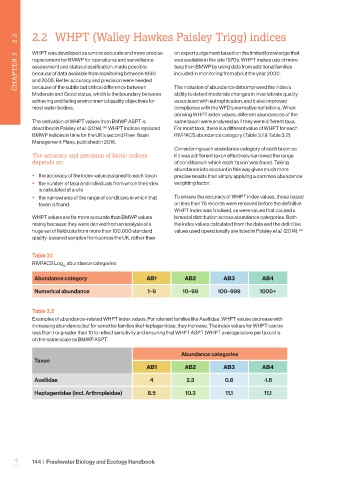
            Table 3.1
            RIVPACS Log  abundance categories
                       10
             Abundance category                      AB1          AB2           AB3          AB4

             Numerical abundance                     1–9         10–99        100–999       1000+


            Table 3.2
            Examples of abundance-related WHPT index values. For tolerant families like Asellidae, WHPT values decrease with
            increasing abundance, but for sensitive families like Heptageniidae, they increase. The index values for WHPT can be
            less than 1 or greater than 10 to reflect sensitivity and ensuring that WHPT ASPT (WHPT average score per taxon) is
            on the same scale as BMWP ASPT.

                                                                 Abundance categories
             Taxon
                                                    AB1           AB2           AB3          AB4
             Asellidae                                4            2.3          0.8           -1.6

             Heptageniidae (incl. Arthropleidae)     8.5          10.3          11.1          11.1


            144  |  Freshwater Biology and Ecology Handbook
      –

