


Page 140 - Freshwater-Biology-and-Ecology-Handbook
P. 140
CHAPTER 3     1.2  1.2  Management context for river invertebrate
            classification


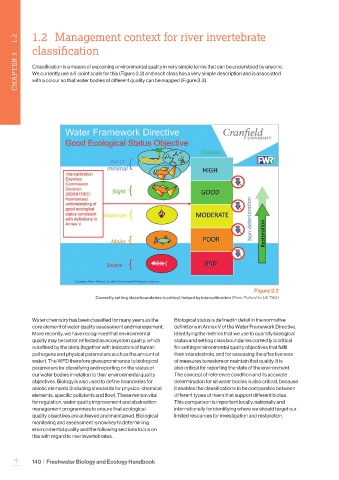
            Classification is a means of explaining environmental quality in very simple terms that can be understood by anyone.
            We currently use a 5-point scale for this (Figure 3.2) and each class has a very simple description and is associated
            with a colour so that water bodies of different quality can be mapped (Figure 3.3).


                                                                                          Figure 3.2
                                   Correctly setting class boundaries is critical, helped by intercalibration (Peter Pollard for UK TAG)


            Water chemistry has been classified for many years as the   Biological status is defined in detail in the normative
            core element of water quality assessment and management.   definitions in Annex V of the Water Framework Directive.
            More recently, we have recognised that environmental   Identifying the metrics that we use to quantify biological
            quality may be better reflected as ecosystem quality, which   status and setting class boundaries correctly is critical
            is defined by the biota (together with indicators of human   for setting environmental quality objectives that fulfil
            pathogens and physical parameters such as the amount of   their intended role, and for assessing the effectiveness
            water). The WFD therefore gives prominence to biological   of measures to restore or maintain that quality. It is
            parameters for classifying and reporting on the status of   also critical for reporting the state of the environment.
            our water bodies in relation to their environmental quality   The concept of reference condition and its accurate
            objectives. Biology is also used to define boundaries for   determination for all water bodies is also critical, because
            abiotic elements (including standards for physico-chemical   it enables the classifications to be comparable between
            elements, specific pollutants and flow). These remain vital   different types of rivers that support different biotas.
            for regulation, water quality improvement and abstraction   This comparison is important locally, nationally and
            management programmes to ensure that ecological   internationally for identifying where we should target our
            quality objectives are achieved and maintained. Biological   limited resources for investigation and restoration.
            monitoring and assessment is now key to determining
            environmental quality and the following sections focus on
            this with regard to river invertebrates.


            140  |  Freshwater Biology and Ecology Handbook
      –

