


Page 191 - Freshwater-Biology-and-Ecology-Handbook
P. 191
3.1  Artificial substrates


            The ‘artificial substrates’ methods are useful in deep and   downstream sites should be as similar as possible. SAufU
            fast flowing sites where there is no access for conventional   are best deployed by mounting them on two bricks, to help
            sampling, or where a more quantitative analysis is   anchor them and prevent them from silting-up when on sand
            needed. Two types of sampling device are recommended   or clay river beds. Ideally, they should be tethered to the
            for collecting invertebrate samples for environmental   bank (perhaps from a tree) using black rope (which is less
            assessment.                                       visible than lighter colours) so that they can be retrieved,
                                                              but care should be taken to avoid areas where boats or
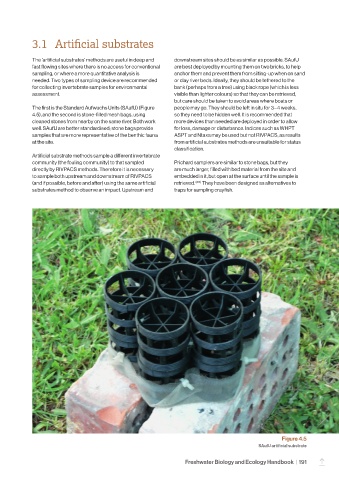
            The first is the Standard Aufwuchs Units (SAufU) (Figure   people may go. They should be left in situ for 3–4 weeks,
            4.5), and the second is stone-filled mesh bags, using   so they need to be hidden well. It is recommended that
            cleaned stones from nearby on the same river. Both work   more devices than needed are deployed in order to allow
            well. SAufU are better standardised; stone bags provide   for loss, damage or disturbance. Indices such as WHPT
            samples that are more representative of the benthic fauna   ASPT and Ntaxa may be used but not RIVPACS, as results
            at the site.                                      from artificial substrates methods are unsuitable for status
                                                              classification.
            Artificial substrate methods sample a different invertebrate
            community (the fouling community) to that sampled   Prichard samplers are similar to stone bags, but they
            directly by RIVPACS methods. Therefore it is necessary   are much larger, filled with bed material from the site and
            to sample both upstream and downstream of RIVPACS   embedded in it, but open at the surface until the sample is
            (and if possible, before and after) using the same artificial   retrieved.  (60)  They have been designed as alternatives to
            substrates method to observe an impact. Upstream and   traps for sampling crayfish.


                                                                                                    Figure 4.5
                                                                                            SAufU artificial substrate

                                                                  Freshwater Biology and Ecology Handbook  |  191
                                                                                                                 –

