


Page 194 - Freshwater-Biology-and-Ecology-Handbook
P. 194
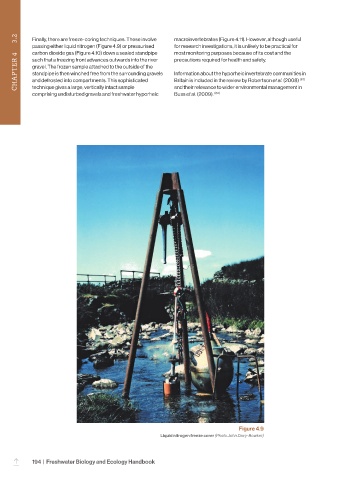
CHAPTER 4     3.2  Finally, there are freeze-coring techniques. These involve   macroinvertebrates (Figure 4.11). However, although useful
            passing either liquid nitrogen (Figure 4.9) or pressurised
                                                              for research investigations, it is unlikely to be practical for
                                                              most monitoring purposes because of its cost and the
            carbon dioxide gas (Figure 4.10) down a sealed standpipe
                                                              precautions required for health and safety.
            such that a freezing front advances outwards into the river
            gravel. The frozen sample attached to the outside of the
                                                              Information about the hyporheic invertebrate communities in
            standpipe is then winched free from the surrounding gravels
            and defrosted into compartments. This sophisticated
                                                                                                          (61)
            technique gives a large, vertically intact sample
                                                              and their relevance to wider environmental management in
                                                              Buss et al. (2009).
                                                                            (62)
            comprising undisturbed gravels and freshwater hyporheic   Britain is included in the review by Robertson et al. (2008)


                                                                                     Figure 4.9
                                                         Liquid nitrogen freeze corer (Photo John Davy-Bowker)


            194  |  Freshwater Biology and Ecology Handbook
      –

