


Page 197 - Freshwater-Biology-and-Ecology-Handbook
P. 197
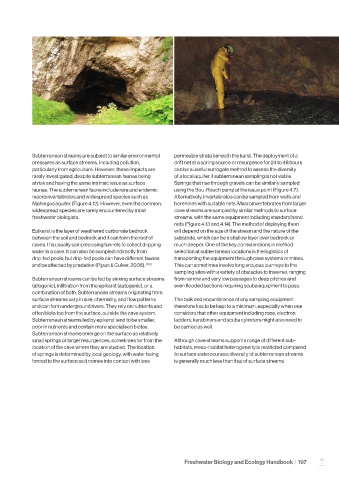
Subterranean streams are subject to similar environmental   permeable strata beneath the karst. The deployment of a
            pressures as surface streams, including pollution,   drift net at a spring source or resurgence for 24 to 48 hours
            particularly from agriculture. However, these impacts are   can be a useful surrogate method to assess the diversity
            rarely investigated, despite subterranean faunas being   of a local aquifer if subterranean sampling is not viable.
            at risk and having the same intrinsic value as surface   Springs that rise through gravels can be similarly sampled
            faunas. The subterranean fauna include rare and endemic   using the Bou-Rouch pump at the issue point (Figure 4.7).
            macroinvertebrates and widespread species such as   Alternatively, invertebrates can be sampled from wells and
            Niphargus aquilex (Figure 4.12). However, even the common,   boreholes with suitable nets. Macroinvertebrates from larger
            widespread species are rarely encountered by most   cave streams are sampled by similar methods to surface
            freshwater biologists.                            streams, with the same equipment including standard hand
                                                              nets (Figure 4.13 and 4.14). The method of deploying them
            Epikarst is the layer of weathered carbonate bedrock   will depend on the size of the stream and the nature of the
            between the soil and bedrock and it can form the roof of   substrate, which can be a shallow layer over bedrock or
            caves. It is usually sampled using funnels to collect dripping   much deeper. One of the key considerations in method
            water in a cave. It can also be sampled indirectly from   selection at subterranean locations is the logistics of
            drip-fed pools, but drip-fed pools can have different faunas   transporting the equipment through cave systems or mines.
            and be affected by predation (Pipan & Culver, 2005).  (63)  This can sometimes involve long arduous journeys to the
                                                              sampling sites with a variety of obstacles to traverse, ranging
            Subterranean streams can be fed by sinking surface streams   from narrow and very low passages to deep pitches and
            (allogenic), infiltration from the epikarst (autogenic), or a   even flooded sections requiring scuba equipment to pass.
            combination of both. Subterranean streams originating from
            surface streams vary in size, chemistry, and flow patterns   The bulk and encumbrance of any sampling equipment
            and can form underground rivers. They rely on nutrients and   therefore has to be kept to a minimum, especially when one
            often biota too from the surface, outside the cave system.   considers that other equipment including rope, electron
            Subterranean streams fed by epikarst tend to be smaller,   ladders, karabiners and scuba cylinders might also need to
            poor in nutrients and contain more specialised biotas.   be carried as well.
            Subterranean streams emerge on the surface as relatively
            small springs or larger resurgences, sometimes far from the   Although cave streams support a range of different sub-
            location of the cave where they are studied. The location   habitats, meso-habitat heterogeneity is restricted compared
            of springs is determined by local geology, with water being   to surface watercourses; diversity of subterranean streams
            forced to the surface as it comes into contact with less   is generally much less than that of surface streams.


                                                                  Freshwater Biology and Ecology Handbook  |  197
                                                                                                                 –

