


Page 201 - Freshwater-Biology-and-Ecology-Handbook
P. 201
3.4.1  Best time for surveys


                                                                          A Riparian Sample is defined
            Although many species are active throughout spring, summer and
            autumn, between the first week in May and the last week in June is   by Natural England as:
            optimal. This is when adult beetle activity is often at its peak.
                                                                          For each of four stations
            Surveys should be carried out during dry weather when river   •  one hour hand searching
            levels are normal or low. It is also crucial to check the long-range   •  an additional 20 minutes excavation
            weather forecast before setting pitfall traps.
                                                                            (on sand and shingle bars only)
                                                                          At one station, usually the one with the
            3.4.2  What is a standard                                     largest area of open sand or shingle
                                                                          •  ten pitfall traps in place for a two-week period
            riparian sample?

                                                                          The combined results can be used to provide
            There are a variety of techniques with no single optimum way   a species list for quality assessment, but
            to survey. Some techniques are rapid and do not require repeat   the results should also be retained for the
            visits whereas other methods collect more individuals but can be   individual stations for two reasons:
            resource intensive. One approach uses a series of techniques   a.  it allows for specific interest features on the
            with the aim of collecting a large diversity of species in a relatively   site to be identified (eg Atheta basicornis
            short time period (Natural England, 2017); see also Webb et al.   found under riparian tree bark at grid ref X)
            (2022).  (65)
                                                                          b.  pitfall trapping was excluded from some
                                                                            earlier surveys; keeping separate records
            On any given stretch of river, four sample stations are selected   of the results (pitfall and hand searching)
            in close proximity to each other (c.200 m). These are usually   allows comparisons with the results of
            identified beforehand and tend to each be located on a sand     earlier surveys.
            or shingle bank and its associated habitats. These are often
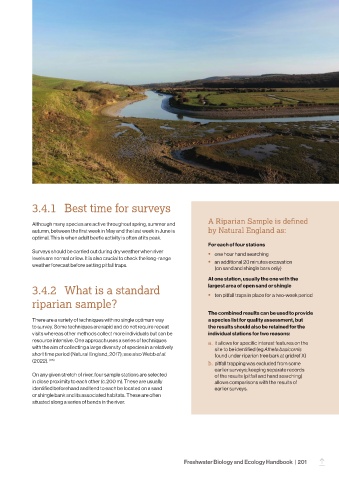
            situated along a series of bends in the river.


                                                                  Freshwater Biology and Ecology Handbook  |  201
                                                                                                                 –

