


Page 234 - Freshwater-Biology-and-Ecology-Handbook
P. 234
CHAPTER 5     3.1.13 – 3.1.14  3.1.13   PSI (Proportion of Sediment-sensitive


            Invertebrates) and E-PSI (Empirically-weighted PSI)


                                                              PSI can be calculated for species (mixed taxonomic level)
            The Proportion of Sediment-sensitive Invertebrates (PSI)
                                – is a proxy to describe the extent
                             (95)
                                                              or family data. Invertebrate taxa are assigned to one of
            – Extence et al. (2011)
                                                              four groups indicating their adaptation to fine sediment
            to which riverbeds are composed of, or covered by, fine
            sediments. It is probably more accurately used as a measure
                                                              deposition (Table 5.7). PSI index values (scores) for each
                                                              taxon depend on their log 10 abundance category.
            of impact of fine sediment, either natural or anthropogenic.
            It is not intended to assess the ecological quality of the
            sediment.
                                                              PSI is calculated as the sum of abundance-related
                                                              values (scores) for sensitive taxa as a percentage of the
                                                              abundance-related values for all taxa.
              PSI – Proportion of Sediment-
              sensitive Invertebrates                         Because the sensitivity ratings depend on abundance,
                                                              PSI should only be calculated for samples collected by the
                                                              standard RIVPAC methods described in Chapter 2.
              This index is used as a measure of the impact of fine
              sediments on invertebrate communities, either natural or
              anthropogenically derived, for example, from soil erosion.

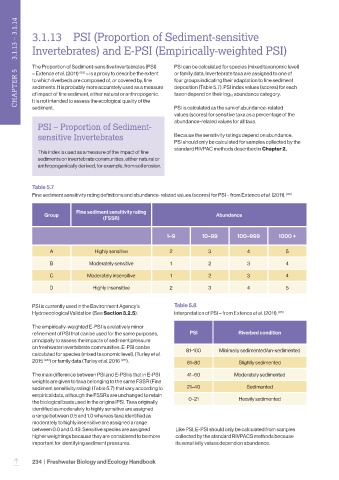
            Table 5.7
            Fine sediment sensitivity rating definitions and abundance-related values (scores) for PSI – from Extence et al. (2011).  (95)


                            Fine sediment sensitivity rating
                 Group                                                       Abundance
                                     (FSSR)

                                                            1–9         10–99       100–999        1000 +

                   A              Highly sensitive           2            3             4            5

                   B            Moderately sensitive         1            2             3            4

                   C            Moderately insensitive       1            2             3            4
                   D              Highly insensitive         2            3             4            5


            PSI is currently used in the Environment Agency’s   Table 5.8
            Hydroecological Validation (See Section 3.2.5).   Interpretation of PSI – from Extence et al. (2011).  (95)

            The empirically-weighted E-PSI is a relatively minor
            refinement of PSI that can be used for the same purposes,   PSI          Riverbed condition
            principally to assess the impacts of sediment pressure
            on freshwater invertebrate communities. E-PSI can be   81–100     Minimally sedimented/un-sedimented
            calculated for species (mixed taxonomic level), (Turley et al.
            2015  (96) ) or family data (Turley et al. 2016  (97) ).   61–80         Slightly sedimented


            The main difference between PSI and E-PSI is that in E-PSI   41–60     Moderately sedimented
            weights are given to taxa belonging to the same FSSR (Fine
            sediment sensitivity rating) (Table 5.7) that vary according to   21–40     Sedimented
            empirical data, although the FSSRs are unchanged to retain   0–21        Heavily sedimented
            the biological basis used in the original PSI. Taxa originally
            identified as moderately to highly sensitive are assigned
            a range between 0.5 and 1.0 whereas taxa identified as
            moderately to highly insensitive are assigned a range
            between 0.0 and 0.49. Sensitive species are assigned   Like PSI, E-PSI should only be calculated from samples
            higher weightings because they are considered to be more   collected by the standard RIVPACS methods because
            important for identifying sediment pressures.      its sensitivity values depend on abundance.


            234  |  Freshwater Biology and Ecology Handbook
      –

