


Page 237 - Freshwater-Biology-and-Ecology-Handbook
P. 237
3.1.16   SPEAR              pesticides


            (Species at risk from pesticides)


            The most widely used version of SPEAR pesticides in the UK is a version devised in 2008
            specifically for the UK. It is used by the Environment Agency and by Salmon and Trout
            Conservation. However, SPEAR pesticides has undergone several refinements since then;
            the current version no longer includes different versions for different regions of Europe.


            The UK version of SPEAR is no longer available in the official SPEAR software, which is
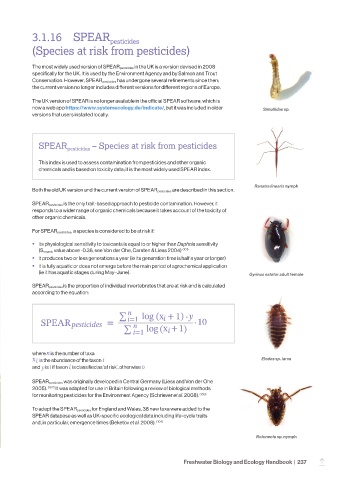
            now a web app https://www.systemecology.de/indicate/, but it was included in older   Simuliidae sp.
            versions that users installed locally.


               SPEAR     pesticides  – Species at risk from pesticides


               This index is used to assess contamination from pesticides and other organic
               chemicals and is based on toxicity data; it is the most widely used SPEAR index.


                                                                                          Ranatra linearis nymph
            Both the old UK version and the current version of SPEAR pesticides are described in this section.

            SPEAR pesticides is the only trait-based approach to pesticide contamination. However, it
            responds to a wider range of organic chemicals because it takes account of the toxicity of
            other organic chemicals.

            For SPEAR pesticides, a species is considered to be at risk if:

            •  its physiological sensitivity to toxicants is equal to or higher than Daphnia sensitivity
               (S organic value above -0.36, see Von der Ohe, Carsten & Liess 2004)  (101)
            •  it produces two or less generations a year (ie its generation time is half a year or longer)
            •  it is fully aquatic or does not emerge before the main period of agrochemical application
               (ie it has aquatic stages during May–June).                               Gyrinus natator adult female

            SPEAR pesticides is the proportion of individual invertebrates that are at risk and is calculated
            according to the equation:


            where   is the number of taxa
                 is the abundance of the taxon                                               Elodes sp. larva
            and   is    if taxon     is classified as ‘at risk’, otherwise

            SPEAR pesticides was originally developed in Central Germany (Liess and Von der Ohe
            2005).  (102)  It was adapted for use in Britain following a review of biological methods
            for monitoring pesticides for the Environment Agency (Schriever et al. 2008).  (103)

            To adapt the SPEAR pesticides for England and Wales, 38 new taxa were added to the
            SPEAR database as well as UK-specific ecological data including life-cycle traits
            and, in particular, emergence times (Beketov et al. 2008).  (104)

                                                                                           Notonecta sp. nymph


                                                                  Freshwater Biology and Ecology Handbook  |  237
                                                                                                                 –

