


Page 292 - Freshwater-Biology-and-Ecology-Handbook
P. 292
CHAPTER 6     10.1.2  10.1.2   Trends and patterns revealed by Environment


            Agency monitoring data


            There have been surprisingly few analyses of the long-term
                                                              There was concern that this improving trend had ceased
                                                              or even reversed, but a recent extension of Vaughan and
            trends in the ecological quality of English rivers. Globally,
                                                              Ormerod’s studies indicate that although increases in
            there is evidence that freshwater insects are not suffering
            the declines observed in terrestrial insect communities
                              (149)
                                  Analysis of Environment Agency
                                                              of invertebrate taxa that are sensitive to oxygen and organic
            (Outhwaite et al. 2020).
                                                              pollutants continues to improve (Pharaoh et al. 2021).
                                                                                                       (152)

            monitoring data by Vaughan and Ormerod (2012, 2014)   taxonomic richness have slowed or halted, the proportion
            at Cardiff University suggest that this is also true of the   https://www.gov.uk/government/publications/an-
            invertebrate faunas in English rivers.  (150) (151)  analysis-of-national-macroinvertebrate-trends-for-
                                                              england-1991-2019
            The original aim of their evaluation was to show the impact
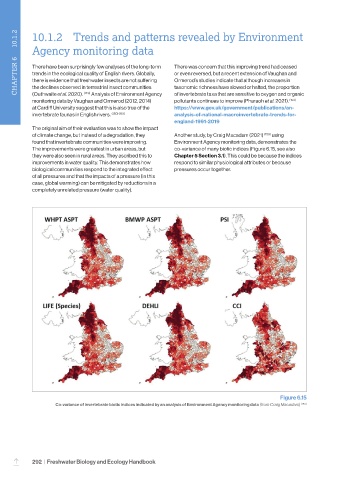
            of climate change, but instead of a degradation, they   Another study, by Craig Macadam (2021)  (153)  using
            found that invertebrate communities were improving.   Environment Agency monitoring data, demonstrates the
            The improvements were greatest in urban areas, but   co-variance of many biotic indices (Figure 6.15, see also
            they were also seen in rural areas. They ascribed this to   Chapter 5 Section 3.1). This could be because the indices
            improvements in water quality. This demonstrates how   respond to similar physiological attributes or because
            biological communities respond to the integrated effect   pressures occur together.
            of all pressures and that the impacts of a pressure (in this
            case, global warming) can be mitigated by reductions in a
            completely unrelated pressure (water quality).


                                                                                                   Figure 6.15
                     Co-variance of invertebrate biotic indices indicated by an analysis of Environment Agency monitoring data (from Craig Macadam)  (153)


            292  |  Freshwater Biology and Ecology Handbook
      –

