


Page 287 - Freshwater-Biology-and-Ecology-Handbook
P. 287
9


                          INVESTIGATIVE MONITORING –

                                              UK EXAMPLE


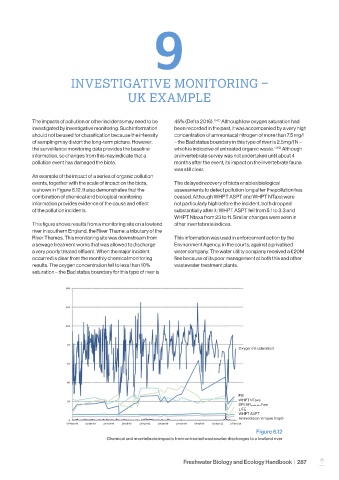
            The impacts of pollution or other incidents may need to be   45% (Defra 2016).  (147)  Although low oxygen saturation had
            investigated by investigative monitoring. Such information   been recorded in the past, it was accompanied by a very high
            should not be used for classification because the intensity   concentration of ammoniacal nitrogen of more than 7.5 mg/l
            of sampling may distort the long-term picture. However,   – the Bad status boundary in this type of river is 2.5mg/l N –
            the surveillance monitoring data provides the baseline   which is indicative of untreated organic waste.  (145)  Although
            information, so changes from this may indicate that a   an invertebrate survey was not undertaken until about 4
            pollution event has damaged the biota.            months after the event, its impact on the invertebrate fauna
                                                              was still clear.
            An example of the impact of a series of organic pollution
            events, together with the scale of impact on the biota,   The delayed recovery of biota enables biological
            is shown in Figure 6.12. It also demonstrates that the   assessments to detect pollution long after the pollution has
            combination of chemical and biological monitoring   ceased. Although WHPT ASPT and WHPT NTaxa were
            information provides evidence of the cause and effect   not particularly high before the incident, both dropped
            of the pollution incidents.                       substantially after it: WHPT ASPT fell from 5.1 to 3.3 and
                                                              WHPT Ntaxa from 23 to 11. Similar changes were seen in
            This figure shows results from a monitoring site on a lowland   other invertebrate indices.
            river in southern England, the River Thame, a tributary of the
            River Thames. This monitoring site was downstream from   This information was used in enforcement action by the
            a sewage treatment works that was allowed to discharge   Environment Agency, in the courts, against a privatised
            a very poorly treated effluent. When the major incident   water company. The water utility company received a £20M
            occurred is clear from the monthly chemical monitoring   fine because of its poor management at both this and other
            results. The oxygen concentration fell to less than 10%   wastewater treatment plants.
            saturation – the Bad status boundary for this type of river is


                                                                                     Oxygen (% saturation)


                                                                                     PSI
                                                                                     WHPT NTaxa
                                                                                     SPEARpesticidesFam
                                                                                     LIFE
                                                                                     WHPT ASPT
                                                                                     Ammoniacal nitrogen (mg/l)

                                                                                           Figure 6.12
                                      Chemical and invertebrate impacts from untreated wastewater discharges to a lowland river


                                                                 Freshwater Biology and Ecology Handbook  |  287
                                                                                                                 –

