


Page 46 - Freshwater-Biology-and-Ecology-Handbook
P. 46
CHAPTER 1     4.1 – 4.2                         4


                        RIVER BASINS – WATER BODIES –

                            CATCHMENTS – TYPOLOGY –

                                   SAMPLING LOCATIONS


            These are the key hydrological and geographical elements of river

            basin management. Understanding of the issues within a river basin
            is essential to the integrated management of these complex systems.


            4.1  River basins


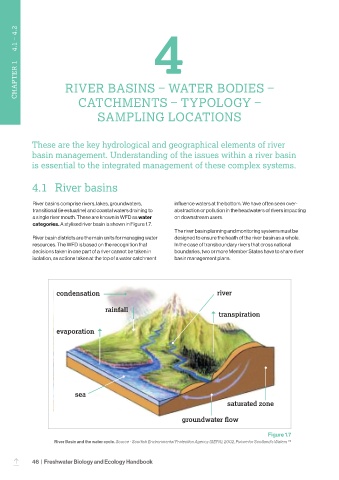
            River basins comprise rivers, lakes, groundwaters,   influence waters at the bottom. We have often seen over-
            transitional (ie estuarine) and coastal waters draining to   abstraction or pollution in the headwaters of rivers impacting
            a single river mouth. These are known in WFD as water   on downstream users.
            categories. A stylised river basin is shown in Figure 1.7.
                                                              The river basin planning and monitoring systems must be
            River basin districts are the main units for managing water   designed to ensure the heath of the river basin as a whole.
            resources. The WFD is based on the recognition that   In the case of transboundary rivers that cross national
            decisions taken in one part of a river cannot be taken in   boundaries, two or more Member States have to share river
            isolation, as actions taken at the top of a water catchment   basin management plans.


                     condensation                                            river


                                      rainfall
                                                                              transpiration


                     evaporation


                           sea
                                                                                 saturated zone

                                                                 groundwater flow

                                                                                               Figure 1.7
                    River Basin and the water cycle. Source - Scottish Environmental Protection Agency (SEPA), 2002, Future for Scotland’s Waters  (11)


            46  |  Freshwater Biology and Ecology Handbook
      –

