


Page 47 - Freshwater-Biology-and-Ecology-Handbook
P. 47
4.2  Water bodies


            Water bodies form the base units for monitoring   a water body within an agricultural catchment would
            programmes and river basin management.            need to be separate from a water body downstream
                                                              of a town where a sewage treatment works discharge
            The key purpose of identifying water bodies is to allow   enters the river. This would be a different risk and require
            ecological objectives to be defined clearly in relation to   different measures for improvement. Natural and heavily
            the pressures acting upon river basins. Consequently,   modified or artificial areas must be designated as
            the water bodies must represent appropriate units for   separate water bodies.
            managing particular pressures or sets of pressures.
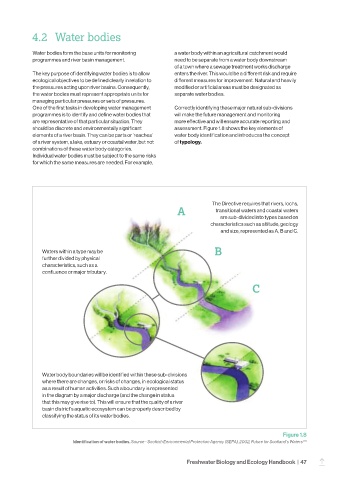
            One of the first tasks in developing water management   Correctly identifying these major natural sub-divisions
            programmes is to identify and define water bodies that   will make the future management and monitoring
            are representative of that particular situation. They   more effective and will ensure accurate reporting and
            should be discrete and environmentally significant   assessment. Figure 1.8 shows the key elements of
            elements of a river basin. They can be parts or ‘reaches’   water body identification and introduces the concept
            of a river system, a lake, estuary or coastal water, but not   of typology.
            combinations of these water body categories.
            Individual water bodies must be subject to the same risks
            for which the same measures are needed. For example,


                                                                           The Directive requires that rivers, lochs,
                                                               A             transitional waters and coastal waters
                                                                              are sub-divided into types based on
                                                                           characteristics such as altitude, geology
                                                                               and size, represented as A, B and C.


                                                                            B
                Waters within a type may be
                further divided by physical
                characteristics, such as a
                confluence or major tributary.

                                                                                          C


                Water body boundaries will be identified within these sub-divisions
                where there are changes, or risks of changes, in ecological status
                as a result of human activities. Such a boundary is represented
                in the diagram by a major discharge (and the change in status
                that this may give rise to). This will ensure that the quality of a river
                basin district’s aquatic ecosystem can be properly described by
                classifying the status of its water bodies.


                                                                                                    Figure 1.8
                           Identification of water bodies. Source - Scottish Environmental Protection Agency (SEPA), 2002, Future for Scotland’s Waters  (11)


                                                                   Freshwater Biology and Ecology Handbook  |  47
                                                                                                                 –

