


Page 53 - Freshwater-Biology-and-Ecology-Handbook
P. 53
The main goal of a monitoring programme is            Aim to avoid sites that are:
            not to assess local features of a stream but to       •  close to artificial influences, such as dams, bridges,
            gain understanding of the ecological quality of         fords, weirs, piers, moorings, reinforced or artificial
            a whole water body or a complete catchment.             banks, and livestock watering areas. If this is not
            Sampling sites should be representative of              possible, the site must represent the water body
                                                                    as a whole. Record any artificial influences on the
            the reach being monitored and therefore                 field data form and take them into account in data
            representative of its biota.                            analysis
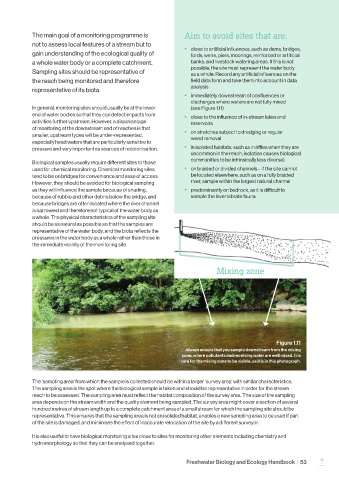
                                                                  •  immediately downstream of confluences or
                                                                    discharges where waters are not fully mixed
            In general, monitoring sites should usually be at the lower   (see Figure 1.11)
            end of water bodies so that they can detect impacts from   •  close to the influence of in-stream lakes and
            activities further upstream. However, a disadvantage    reservoirs
            of monitoring at the downstream end of reaches is that   •  on stretches subject to dredging or regular
            smaller, upstream types will be under-represented,      weed removal
            especially head waters that are particularly sensitive to
            pressure and very important as sources of recolonisation.  •  in isolated habitats, such as in riffles when they are
                                                                    uncommon in the reach; isolation causes biological
                                                                    communities to be intrinsically less diverse)
            Biological samples usually require different sites to those
            used for chemical monitoring. Chemical monitoring sites   •  on braided or divided channels – if the site cannot
            tend to be on bridges for convenience and ease of access.   be located elsewhere, such as on a fully braided
            However, they should be avoided for biological sampling   river, sample within the largest natural channel
            as they will influence the sample because of shading,   •  predominantly on bedrock, as it is difficult to
            because of rubble and other debris below the bridge, and   sample the invertebrate fauna.
            because bridges are often located where the river channel
            is narrowest and therefore not typical of the water body as
            a whole. The physical characteristics of the sampling site
            should be as natural as possible so that the samples are
            representative of the water body, and the biota reflects the
            pressures in the water body as a whole rather than those in
            the immediate vicinity of the monitoring site.


                                                                             Mixing zone


                                                                                                  Figure 1.11
                                                                  Always ensure that you sample downstream from the mixing
                                                                 zone, where pollutants and receiving water are well mixed. It is
                                                                 rare for the mixing zone to be visible, as it is in this photograph.


            The ‘sampling area’ from which the sample is collected should be within a larger ‘survey area’ with similar characteristics.
            The sampling area is the spot where the biological sample is taken and should be representative in order for the stream
            reach to be assessed. The sampling area must reflect the habitat composition of the survey area. The size of the sampling
            area depends on the stream width and the quality element being sampled. The survey area might cover a section of several
            hundred metres of stream length up to a complete catchment area of a small stream for which the sampling site should be
            representative. This ensures that the sampling area is not an isolated habitat, enables a new sampling area to be used if part
            of the site is damaged, and minimises the effect of inaccurate relocation of the site by a different surveyor.

            It is also useful to have biological monitoring sites close to sites for monitoring other elements including chemistry and
            hydromorphology so that they can be analysed together.


                                                                  Freshwater Biology and Ecology Handbook  |  53
                                                                                                                 –

