


Page 56 - Freshwater-Biology-and-Ecology-Handbook
P. 56
CHAPTER 1     5.1  5.1  Introduction                   of water classification and management. It ensures

            In order to assess and report the quality of surface waters it
            is essential to develop a method of comparing water bodies
                                                              that all the quality elements needed to provide for a
                                                              balanced ecosystem are in place within a given class.
            in a consistent and transparent way that is easy for anyone
                                                              However, it causes difficulty because as more elements
            to understand. This is known as classification. Knowledge
            of compliance against classifications drives the river basin
                                                              misclassification for purely statistical reasons caused by
            planning process and is used to target investment to meet
                                                              errors being additive. This tends to give a pessimistic view
            the agreed objectives.                            are considered, the greater the risk of a downgraded
                                                              of quality. Also, improvements in individual elements may
            The classification process results in each surface water   be masked by failures of other elements. For example, the
            body being assigned a status class. The WFD uses a five-  biological quality may have improved due to pollution control
            class system for each surface water type. These status   actions, but one or more chemical elements may have failed,
            classes are termed: high, good, moderate, poor, and bad.   leading to an overall failure of good status. This is shown
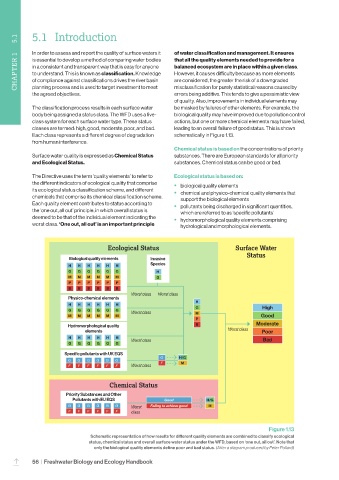
            Each class represents a different degree of degradation   schematically in Figure 1.13.
            from human interference.
                                                              Chemical status is based on the concentrations of priority
            Surface water quality is expressed as Chemical Status   substances. There are European standards for all priority
            and Ecological Status.                            substances. Chemical status can be good or bad.

            The Directive uses the term ‘quality elements’ to refer to   Ecological status is based on:
            the different indicators of ecological quality that comprise   •  biological quality elements
            its ecological status classification scheme, and different   •  chemical and physico-chemical quality elements that
            chemicals that comprise its chemical classification scheme.   support the biological elements
            Each quality element contributes to status according to   •  pollutants being discharged in significant quantities,
            the ‘one out, all out’ principle, in which overall status is   which are referred to as ‘specific pollutants’
            deemed to be that of the individual element indicating the   •  hydromorphological quality elements comprising
            worst class. ‘One out, all out’ is an important principle   hydrological and morphological elements.


                                       Ecological Status                            Surface Water
                                                                                        Status
                         Biological quality elements  Invasive
                                                      Species
                         H  H   H  H  H   H
                         G  G   G  G  G   G             H
                         M  M   M  M  M   M             G
                         P  P   P  P  P   P
                         B  B   B  B  B   B
                                               Worst class  Worst class
                         Physico-chemical elements
                                                                      H
                         H  H   H  H  H   H
                                                                      G                      High
                         G  G   G  G  G   G    Worst class            M
                         M  M   M  M  M   M                                                  Good
                                                                      P
                         Hydromorphological quality                   B                    Moderate
                               elements                                          Worst class  Poor
                         H  H   H  H  H   H                                                  Bad
                         G  G   G  G  G   G    Worst class
                        Specific pollutants with UK EQS
                                                         G      H/G
                         G  G   G  G  G   G
                         F  F   F  F  F   F    Worst class  F    M


                                       Chemical Status
                        Priority Substances and Other
                          Pollutants with EU EQS           Good           H/G
                         G  G   G  G  G   G    Worst   Failing to achieve good  M
                         F  F   F  F  F   F    class

                                                                                               Figure 1.13
                                 Schematic representation of how results for different quality elements are combined to classify ecological
                                status, chemical status and overall surface water status under the WFD, based on ‘one out, all out’. Note that
                                  only the biological quality elements define poor and bad status. (After a diagram produced by Peter Pollard)
            56  |  Freshwater Biology and Ecology Handbook
      –

