


Page 57 - Freshwater-Biology-and-Ecology-Handbook
P. 57
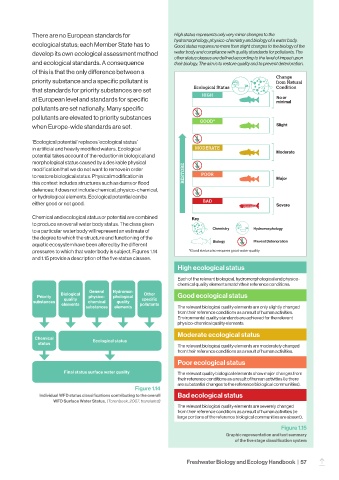
There are no European standards for               High status represents only very minor changes to the
                                                              hydromorphology, physico-chemistry and biology of a water body.
            ecological status; each Member State has to       Good status requires no more than slight changes to the biology of the
            develop its own ecological assessment method      water body and compliance with quality standards for pollutants. The
                                                              other status classes are defined according to the level of impact upon
            and ecological standards. A consequence           their biology. The aim is to restore quality and to prevent deterioration.
            of this is that the only difference between a
                                                                                                  Change
            priority substance and a specific pollutant is                                        from Natural
            that standards for priority substances are set           Ecological Status            Condition
                                                                        HIGH
                                                                                                  No or
            at European level and standards for specific                                          minimal
            pollutants are set nationally. Many specific
            pollutants are elevated to priority substances
                                                                       GOOD*
            when Europe-wide standards are set.                                                   Slight

            ‘Ecological potential’ replaces ‘ecological status’
            in artificial and heavily modified waters. Ecological     MODERATE                    Moderate
            potential takes account of the reduction in biological and
            morphological status caused by a desirable physical
            modification that we do not want to remove in order
            to restore biological status. Physical modification in   RESTORE  POOR                Major
            this context includes structures such as dams or flood
            defences; it does not include chemical, physico-chemical,
            or hydrological elements. Ecological potential can be
            either good or not good.                                    BAD                       Severe

            Chemical and ecological status or potential are combined   Key
            to produce an overall water body status. The class given
            to a particular water body will represent an estimate of        Chemistry     Hydromorphology
            the degree to which the structure and functioning of the                      Prevent Deterioration
            aquatic ecosystem have been altered by the different            Biology
            pressures to which that water body is subject. Figures 1.14   *Good status also requires good water quality
            and 1.15 provide a description of the five status classes.
                                                               High ecological status
                                                               Each of the relevant biological, hydromorphological and physico-
                                                               chemical quality elements match their reference conditions.
                                General   Hydromor-
                      Biological                    Other      Good ecological status
              Priority   quality   physico-   phological   specific
             substances         chemical   quality
                       elements                   pollutants
                               substances  elements            The relevant biological quality elements are only slightly changed
                                                               from their reference conditions as a result of human activities.
                                                               Environmental quality standards are achieved for the relevant
                                                               physico-chemical quality elements.
                                                               Moderate ecological status
             Chemical             Ecological status
              status
                                                               The relevant biological quality elements are moderately changed
                                                               from their reference conditions as a result of human activities.
                                                               Poor ecological status
                        Final status surface water quality     The relevant quality biological elements show major changes from
                                                               their reference conditions as a result of human activities (ie there
                                                               are substantial changes to the reference biological communities).
                                                Figure 1.14
               Individual WFD status classifications contributing to the overall   Bad ecological status
                    WFD Surface Water Status. (Torenbeek, 2007, translated)
                                                               The relevant biological quality elements are severely changed
                                                               from their reference conditions as a result of human activities (ie
                                                               large portions of the reference biological communities are absent).
                                                                                                    Figure 1.15
                                                                                Graphic representation and text summary
                                                                                    of the five stage classification system


                                                                   Freshwater Biology and Ecology Handbook  |  57
                                                                                                                 –

