


Page 145 - Freshwater-Biology-and-Ecology-Handbook
P. 145
Because Chironomidae and Oligochaeta are found in almost   could be allocated to each family far more accurately than
            all invertebrate samples, the index values derived for these   they could to species because a far larger data set was
            taxa were essentially the average value across the whole   available from which to derive the index values. We did not
            quality spectrum. That would have elevated WHPT ASPT   base WHPT indices on families to save costs.
            values at sites with strong organic pollution, when these taxa
            but few others are present. As a result, the definitive index   The regulatory agencies in Great Britain actually analyse
            values used for Oligochaeta were those derived for the   invertebrate samples to a mixed taxonomic level that is
            most tolerant family, Tubificidae, and index values used for   mostly to species, so that monitoring data can be used
            Chironomidae were the values for Chironomini, as they had   to track invasive species as well as subtle effects from
            been in the BMWP index to allow the most polluted sites to   emerging pressures such as climate change. Because they
            have very low WHPT ASPTs.                         share similar physiology, many species of river invertebrates
                                                              belonging to the same family have similar tolerances to
            We considered developing species-level indices to increase   pollution and other pressures, with only a few notable
            the number of taxa from which the index is calculated and   exceptions. This causes species-level versions of indices
            to narrow the range of conditions from which each taxon is   that also have family-level versions to offer little additional
            found. When WHPT was developed, however, index values   precision or accuracy.


              Like BMWP, WHPT is used in two                  WHPT NTaxa is a measure of taxonomic richness
              complementary forms: the average WHPT           and it (and status classification based on it) responds
              score per taxon (WHPT ASPT) and the number      to all types of environmental pressures, including
              of WHPT scoring taxa (WHPT NTaxa).              toxic chemicals.
                                                              We use this index because WHPT ASPT cannot
              WHPT ASPT is the average sensitivity of         detect certain pollutants, in particular those caused
              invertebrates to organic and nutrient loads and other   by acidification and metal pollution, which is common
              pressures associated with domestic or mixed waste   in mine water and industrial discharges. WHPT NTaxa
              discharges (fine sediment, ammonia toxicity) or that   is less precise than WHPT ASPT because it is not an
              affect dissolved oxygen and productivity (reduced   average, and it is more sensitive to laboratory error
              flow, reduced shading).                         and sampling variation. Beware that poorer NTaxa
                                                              (ie fewer taxa) sometimes represents better quality:
              Status classification based on WHPT ASPT reflects   in oligotrophic upland streams, particularly with low
              these pressures, which are still the most widespread   alkalinity, mild organic pollution can increase NTaxa,
              combination of environmental pressures that impact   although the composition of taxa may change and be
              river invertebrate communities. Although nominally   reflected in poorer ASPT.
              an index of saprobity (organic loading), WHPT ASPT
              is actually a multi-pressure index (as are all indices of   The combination of WHPT-ASPT and WHPT NTaxa
              organic pollution) because all these pressures interact   responds to virtually all combinations of pressures.
              and can co-exist. River invertebrates are particularly   Using WHPT ASPT and WHPT NTaxa together not
              sensitive to dissolved oxygen and anything that   only provides a measure of ecological quality but
              impedes their respiration.                      also gives a limited diagnostic capability that enables
                                                              sites affected predominantly by organic and related
              The wide range of tolerances of different taxa enables   pressures to be differentiated from those affected by
              the strength of these pressures to be measured   toxic pressures. High WHPT ASPT but low WHPT
              relatively accurately across a wide range of intensity.   NTaxa indicates an absence of organic or related
              The precision of WHPT ASPT is enhanced by being an   pressures (indicated by the presence of sensitive taxa)
              average and is relatively insensitive to sampling effort.  but the presence of another type of pressure, which
                                                              must either be toxic metal/acidification or habitat
                                                              degradation. When both WHPT ASPT and WHPT
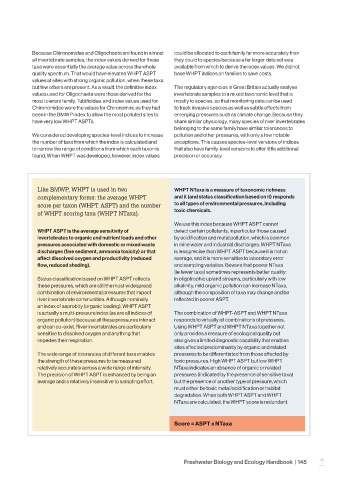
                                                              NTaxa are calculated, the WHPT score is redundant.


                                                              Score = ASPT x NTaxa


                                                                  Freshwater Biology and Ecology Handbook  |  145
                                                                                                                 –

