


Page 150 - Freshwater-Biology-and-Ecology-Handbook
P. 150
CHAPTER 3     3.1.1  The mountain stream is a physically stressful environment   because less oxygen is also associated with organic

            with very fast and flashy flow, unstable rocky bed, and it
                                                              pollution. There is a greater organic loading in the chalk
                                                              stream because of its higher productivity, and this supports
            is relatively cold. Its low productivity provides little food
                                                              a much larger community of species that can tolerate the low
            for invertebrates. Its hard geology causes greater acidity
                                                              oxygen concentrations. As a result, the value of WHPT ASPT
            in which toxic metals from the rock are present in more
                                                              is substantially lower in a chalk stream than it is in a mountain
            bioavailable forms.
            Few species are able to live in mountain streams and this
                                                              The example above is extreme, but even within the same
            is reflected in a relatively low value of WHPT NTaxa. The   stream of similar quality.
            larger chalk stream is more benign with a more stable flow   river catchment, natural differences in invertebrate
            and riverbed, and its higher productivity provides plenty   communities can cause significant variations in the values of
            of food. It supports more ecological niches and therefore   biotic indices independent of the impacts of human activity,
            more taxa. WHPT NTaxa in the chalk stream is twice that in   reflecting the natural change in character of a river from
            the mountain stream. The turbulent water in the mountain   headwaters to the sea or between catchments on different
            stream is well aerated and shallow, so oxygen is always   geologies. Even small differences in index values caused by
            saturated and taxa that are very intolerant of lower oxygen   natural environmental conditions can be important, because
            concentrations can survive. The chalk stream has smoother   the differences between Good and Moderate WFD status,
            flow and is deeper, so re-oxygenation from the atmosphere   ie between communities passing and failing environmental
            is slower than in the mountain stream. Its luxuriant emergent   quality objectives, are relatively small.
            and submerged vegetation causes oxygen to become
            super-saturated during the day, but when photosynthesis   This phenomenon affects all biotic indices and metrics. Table
            stops at night, the oxygen concentration falls dramatically   3.3 shows the range of values for a selection of biotic indices
            because the plants continue to respire. Animals living in   from the RIVPACS reference database from High to Good
            chalk streams therefore have to be able to survive with less   (best available) quality sites.
            oxygen and those taxa tend to have lower WHPT values


            Table 3.3
            Variation of a range of indices between stream types, illustrated by the minimum and
            maximum values in the RIVPACS reference database, all sites being high or best
            available quality


             Index                                     Min           Max

             TL1 NTaxa                                  3             46
             TL1 ASPT                                  3.6            8
             TL2 WHPT NTaxa (AbW,DistFam)               3             56

             TL2 WHPT ASPT (AbW,DistFam)               3.1           9.4
             TL5 WFD AWIC(Sp)                           0             14

             TL4 MetTol                                36.3          58.1
             TL3 LIFE(Fam) (DistFam)                   4.6           9.5

             TL4 LIFE(Sp)                              4.8           9.7
             TL3 PSI(Fam)                               0            100

             TL4 PSI(Sp)                                0            100
             TL3 E-PSI(fam69)                           0            100

             TL4 E-PSI(mixed level)                     0            100
             TL2 08 Group ARMI Score                    1             26
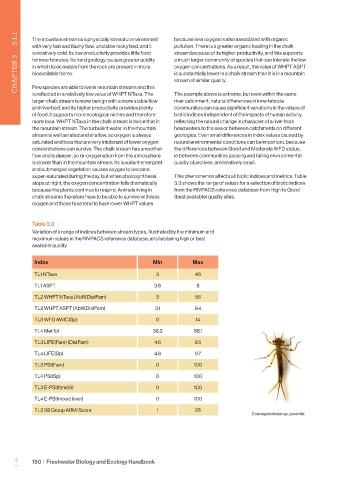
                                                                                         Coenagrionidae sp. juvenile


            150  |  Freshwater Biology and Ecology Handbook
      –

