


Page 146 - Freshwater-Biology-and-Ecology-Handbook
P. 146
CHAPTER 3     2.3 – 2.5  2.3  Comparison of BMWP


            and WHPT


            WHPT ASPT is on the same scale as WHPT BMWP. The only
            difference, apart from improved accuracy and precision, is the greater
            sensitivity of WHPT ASPT to mild enrichment that affects abundances
            but not species composition. WHPT NTaxa responds to the same
            environmental pressures as BMWP NTaxa but it is not on the same
            scale because it is based on a greater number of taxa (106 taxa in
            WHPT and only 82 in BMWP). WHPT includes more families of Diptera,
            and the constituents of composite families in BMWP are treated as
            distinct families in WHPT.

            2.4  Calculating WHPT indices


            For status classification, WHPT must be calculated at RIVPACS
            Taxon Level 2 (ie including families not included in BMWP), with
            BMWP composite taxa separated into individual families and using
            abundance-related index values. This is erroneously termed ‘WHPT
            abundance-weighted with distinct families’ in RIVPACS (River
            Invertebrate Prediction and Classification System) and RICT (River
            Invertebrate Classification Tool): WHPT does not use abundance
            weighting but gives independently defined index values for different
            abundances of each taxon (Section 2.2). If you do not have abundance
            data, or only have data for BMWP taxa including composite families,
            you can still estimate WHPT, but not for status classification.
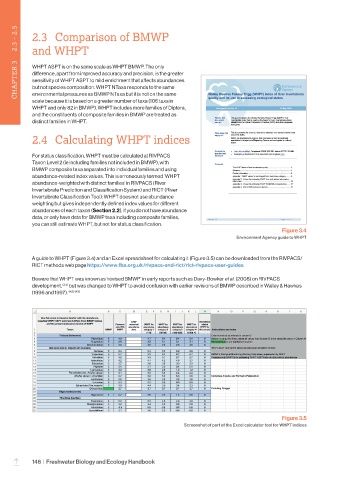
                                                                                                    Figure 3.4
                                                                                    Environment Agency guide to WHPT


            A guide to WHPT (Figure 3.4) and an Excel spreadsheet for calculating it (Figure 3.5) can be downloaded from the RIVPACS/
            RICT methods web page https://www.fba.org.uk/rivpacs-and-rict/rict-rivpacs-user-guides
            Beware that WHPT was known as ‘revised BMWP’ in early reports such as Davy-Bowker et al. (2008) on RIVPACS
            development,  (34)  but was changed to WHPT to avoid confusion with earlier revisions of BMWP described in Walley & Hawkes
            (1996 and 1997).  (42) (43)


                                                                                                    Figure 3.5
                                                                  Screenshot of part of the Excel calculator tool for WHPT indices


            146  |  Freshwater Biology and Ecology Handbook
      –

