


Page 147 - Freshwater-Biology-and-Ecology-Handbook
P. 147
2.5  Correcting bias caused by analytical error


            Analytical quality affects our assessment of river   deduced. To ensure that differences in analytical quality
            invertebrate quality, particularly when we use taxonomic   are not mistaken for differences in environmental quality,
            richness as a measure of quality, such as WHPT NTaxa (the   we make a ‘bias correction’ to the observed data, based on
            number of WHPT-scoring taxa). We have measured these   the result of audits in which sorting errors were measured
            errors in independent audits. Audit ‘gains’ caused by taxa   independently, before using it to determine WFD status.
            present in a sample in low numbers or as a single specimen
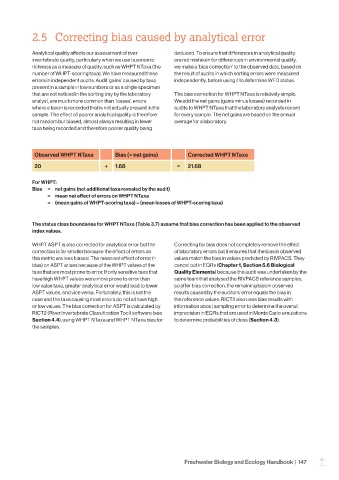
            that are not noticed in the sorting tray by the laboratory   The bias correction for WHPT NTaxa is relatively simple.
            analyst, are much more common than ‘losses’, errors   We add the net gains (gains minus losses) recorded in
            where a taxon is recorded that is not actually present in the   audits to WHPT NTaxa that the laboratory analysts record
            sample. The effect of poorer analytical quality is therefore   for every sample. The net gains are based on the annual
            not random but biased, almost always resulting in fewer   average for a laboratory.
            taxa being recorded and therefore poorer quality being


             Observed WHPT NTaxa         Bias (= net gains)        Corrected WHPT NTaxa

             20                       +  1.68                  =   21.68

            For WHPT:
            Bias  =  net gains (net additional taxa revealed by the audit)
                  =  mean net effect of errors on WHPT NTaxa
                  =  (mean gains of WHPT-scoring taxa) – (mean losses of WHPT-scoring taxa)


            The status class boundaries for WHPT NTaxa (Table 3.7) assume that bias correction has been applied to the observed
            index values.

            WHPT ASPT is also corrected for analytical error but the   Correcting for bias does not completely remove the effect
            correction is far smaller because the effect of errors on   of laboratory errors but it ensures that the bias in observed
            this metric are less biased. The mean net effect of error (=   values match the bias in values predicted by RIVPACS. They
            bias) on ASPT arises because of the WHPT values of the   cancel out in EQRs (Chapter 1, Section 5.6 Biological
            taxa that are most prone to error. If only sensitive taxa that   Quality Elements) because the audit was undertaken by the
            have high WHPT values were more prone to error than   same team that analysed the RIVPACS reference samples,
            low value taxa, greater analytical error would lead to lower   so after bias correction, the remaining bias in observed
            ASPT values, and vice versa. Fortunately, this is not the   results caused by the auditors’ error equals the bias in
            case and the taxa causing most errors do not all have high   the reference values. RICT2 also uses bias results with
            or low values. The bias correction for ASPT is calculated by   information about sampling error to determine the overall
            RICT2 (River Invertebrate Classification Tool) software (see   imprecision in EQRs that are used in Monte Carlo simulations
            Section 4.4), using WHPT NTaxa and WHPT NTaxa bias for   to determine probabilities of class (Section 4.3).
            the samples.


                                                                  Freshwater Biology and Ecology Handbook  |  147
                                                                                                                 –

