


Page 152 - Freshwater-Biology-and-Ecology-Handbook
P. 152
CHAPTER 3     3.1.2 – 3.1.3  3.1.2  The solution: RIVPACS community prediction


            In October 1977 the River Communities
            Project started to investigate whether the
                                                                The key conclusion was that similar communities existed
            natural invertebrate communities in different
                                                                wherever environmental conditions were the same.
            streams were each unique or whether the same
                                                                predict the invertebrate community.
            communities were found in any river where the
            same environmental conditions existed.              If you know the environmental conditions, you can

            Invertebrates were sampled from a wide range of   After identifying the combination of environmental
            unpolluted rivers across the UK and at these sites a wide   parameters that most closely distinguished the invertebrate
            range of environmental parameters were measured. To   communities, a predictive model was developed, known as
            ensure comparability, standard methods for sampling and   RIVPACS (River Invertebrate Prediction and Classification
            analysis were devised and these are the standard methods   System).
            described in Chapter 2. The invertebrate communities
            were characterised by their species composition and   Early developments of RIVPACS are described in Wright
            abundances. Because the communities change throughout   et al. (2000).  (44)  Using the current version of RIVPACS
            the year, samples were collected in spring, summer and   to predict river communities, ie species composition, is
            autumn. All macroinvertebrate taxa in the samples were   described in Chapter 5 Section 3.2.1.
            identified to species or as far as was practicable at the time,
            and their abundances recorded.


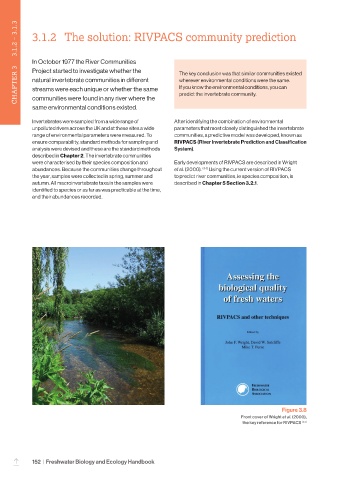
                                                                                                    Figure 3.8
                                                                                      Front cover of Wright et al. (2000),
                                                                                      the key reference for RIVPACS   (44)


            152  |  Freshwater Biology and Ecology Handbook
      –

