


Page 60 - Freshwater-Biology-and-Ecology-Handbook
P. 60
CHAPTER 1     5.3  5.3  Ecological Status


            Ecological status is an expression of the quality of the structure and

            functioning of surface water ecosystems as indicated by the condition
            of a number of ‘quality elements’.


            The biological quality elements drive ecological status   The WFD provides descriptive ‘normative definitions’ for
            assessment. The other quality elements are supporting   high, good and moderate status of all the ecological quality
            factors. They are environmental parameters that, in the   elements. Figure 1.16 provides these important definitions,
            right amounts, are essential to biological communities.   and specific text from the WFD is included here.
            Their class boundaries are set at values that ensure
            good or better biological status.

             Element    High Status                            Good Status         Moderate Status

             General    There are no, or only very minor, anthropogenic   The values of the   The values of the biological
                        alterations to the values of the physico-chemical   biological quality   quality elements for the
                        and hydromorphological quality elements for the   elements for the   surface water body type
                        surface water body type from those normally   surface water body   deviate moderately from those
                        associated with that type under undisturbed   type show low levels   normally associated with the
                        conditions.                            of distortion resulting   surface water body type under
                                                               from human activity,   undisturbed conditions. The
                        The values of the biological quality elements for   but deviate only slightly   values show moderate signs of
                        the surface water body reflect those normally   from those normally   distortion resulting from human
                        associated with that type under undisturbed   associated with the   activity and are significantly
                        conditions, and show no, or only very minor,   surface water body   more disturbed than under
                        evidence of distortion.                type under undisturbed   conditions of good status.
                                                               conditions.
                        These are the type-specific conditions and
                        communities.

                                                                                                    Figure 1.16
                                                                      Normative definitions of ecological status classifications
                                                                            (from the WFD). See also the bullet points below.

                                                              •  Waters achieving a status below moderate shall be
                                                                classified as poor or bad.
                                                              •  Waters showing evidence of major alterations to the
                                                                values of the biological quality elements for the surface
                                                                water body type and in which the relevant biological
                                                                communities deviate substantially from those normally
                                                                associated with the surface water body type under
                                                                undisturbed conditions, shall be classified as poor.
                                                              •  Waters showing evidence of severe alterations to the
                                                                values of the biological quality elements for the surface
                                                                water body type and in which large portions of the
                                                                relevant biological communities normally associated
                                                                with the surface water body type under undisturbed
                                                                conditions are absent, shall be classified as bad.

                                                              As mentioned previously, there are five classes of ecological
                                                              status: high, good, moderate, poor and bad. The Directive
                                                              requires that the overall ecological status of a water body
                                                              be determined by the results for the biological or physico-
                                                              chemical quality element that has the worst status class
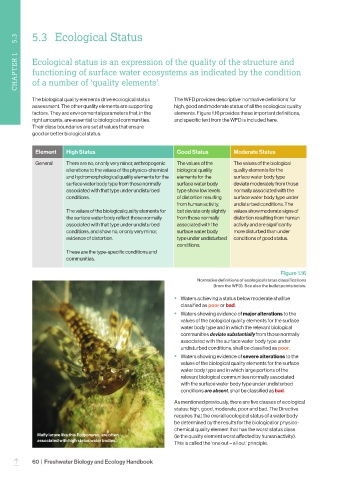
              Mafly larave like this Ecdyonurus, are often    (ie the quality element worst affected by human activity).
              associated with high status water bodies.
                                                              This is called the ‘one out – all out’ principle.

            60  |  Freshwater Biology and Ecology Handbook
      –

