


Page 65 - Freshwater-Biology-and-Ecology-Handbook
P. 65
5.6  Biological quality elements


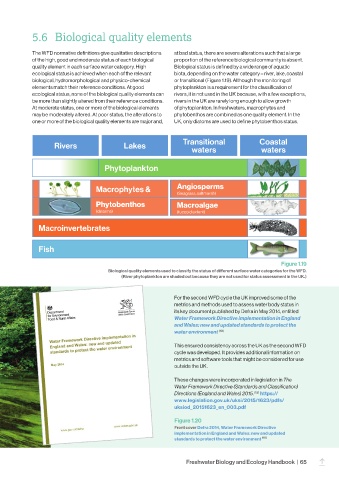
            The WFD normative definitions give qualitative descriptions   at bad status, there are severe alterations such that a large
            of the high, good and moderate status of each biological   proportion of the reference biological community is absent.
            quality element in each surface water category. High   Biological status is defined by a wide range of aquatic
            ecological status is achieved when each of the relevant   biota, depending on the water category – river, lake, coastal
            biological, hydromorphological and physico-chemical   or transitional (Figure 1.19). Although the monitoring of
            elements match their reference conditions. At good   phytoplankton is a requirement for the classification of
            ecological status, none of the biological quality elements can   rivers, it is not used in the UK because, with a few exceptions,
            be more than slightly altered from their reference conditions.   rivers in the UK are rarely long enough to allow growth
            At moderate status, one or more of the biological elements   of phytoplankton. In freshwaters, macrophytes and
            may be moderately altered. At poor status, the alterations to   phytobenthos are combined as one quality element. In the
            one or more of the biological quality elements are major and,   UK, only diatoms are used to define phytobenthos status.


                                                                 Transitional               Coastal
                    Rivers                   Lakes                  waters                   waters


                                        Phytoplankton


                                   Macrophytes &               Angiosperms
                                                                (Seagrass, saltmarsh)
                                   Phytobenthos                Macroalgae
                                   (diatoms)                    (fuccoid extent)

                 Macroinvertebrates


                 Fish

                                                                                                    Figure 1.19
                                       Biological quality elements used to classify the status of different surface water categories for the WFD.
                                            (River phytoplankton are shaded out because they are not used for status assessment in the UK.)


                                                              For the second WFD cycle the UK improved some of the
                                                              metrics and methods used to assess water body status in
                                                              its key document published by Defra in May 2014, entitled
                                                              Water Framework Directive implementation in England
                                                              and Wales: new and updated standards to protect the
                                                                              (19)
                                                              water environment
                                                              This ensured consistency across the UK as the second WFD
                                                              cycle was developed. It provides additional information on
                                                              metrics and software tools that might be considered for use
                                                              outside the UK.

                                                              These changes were incorporated in legislation in The
                                                              Water Framework Directive (Standards and Classification)
                                                              Directions (England and Wales) 2015.   https://
                                                                                          (18)
                                                              www.legislation.gov.uk/uksi/2015/1623/pdfs/
                                                              uksiod_20151623_en_003.pdf

                                                              Figure 1.20
                                                              Front cover Defra 2014, Water Framework Directive
                                                              implementation in England and Wales: new and updated
                                                              standards to protect the water environment  (19)


                                                                  Freshwater Biology and Ecology Handbook  |  65
                                                                                                                 –

