


Page 66 - Freshwater-Biology-and-Ecology-Handbook
P. 66
CHAPTER 1     5.6  Table 1.12  Element  Metric                                Software Tool
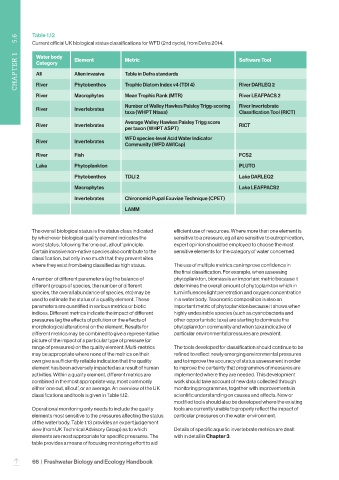
            Current official UK biological status classifications for WFD (2nd cycle), from Defra 2014.

              Water body
              Category

                           Alien invasive
              All
                                             Table in Defra standards
              River
                                             Mean Trophic Rank (MTR)
                                                                                     River LEAFPACS 2
                           Macrophytes
              River        Phytobenthos      Trophic Diatom Index v4 (TDI 4)         River DARLEQ 2
                                             Number of Walley Hawkes Paisley Trigg-scoring   River Invertebrate
              River        Invertebrates
                                             taxa (WHPT Ntaxa)                       Classification Tool (RICT)
                                             Average Walley Hawkes Paisley Trigg score
              River        Invertebrates                                             RICT
                                             per taxon (WHPT ASPT)
                                             WFD species-level Acid Water Indicator
              River        Invertebrates
                                             Community (WFD AWICsp)
              River        Fish                                                      FCS2

              Lake         Phytoplankton                                             PLUTO
                           Phytobenthos      TDLI 2                                  Lake DARLEQ2
                           Macrophytes                                               Lake LEAFPACS2

                           Invertebrates     Chironomid Pupal Exuviae Technique (CPET)
                                             LAMM


            The overall biological status is the status class indicated   efficient use of resources. Where more than one element is
            by whichever biological quality element indicates the   sensitive to a pressure, eg all are sensitive to eutrophication,
            worst status, following the ‘one out, all out’ principle.   expert opinion should be employed to choose the most
            Certain invasive non-native species also contribute to the   sensitive elements for the category of water concerned.
            classification, but only in so much that they prevent sites
            where they exist from being classified as high status.  The use of multiple metrics can improve confidence in
                                                              the final classification. For example, when assessing
            A number of different parameters (eg the balance of   phytoplankton, biomass is an important metric because it
            different groups of species, the number of different   determines the overall amount of phytoplankton which in
            species, the overall abundance of species, etc) may be   turn influences light penetration and oxygen concentration
            used to estimate the status of a quality element. These   in a water body. Taxonomic composition is also an
            parameters are quantified in various metrics or biotic   important metric of phytoplankton because it shows when
            indices. Different metrics indicate the impact of different   highly undesirable species (such as cyanobacteria and
            pressures (eg the effects of pollution or the effects of   other opportunistic taxa) are starting to dominate the
            morphological alterations) on the element. Results for   phytoplankton community and when taxa indicative of
            different metrics may be combined to give a representative   particular environmental pressures are prevalent.
            picture of the impact of a particular type of pressure (or
            range of pressures) on the quality element. Multi-metrics   The tools developed for classification should continue to be
            may be appropriate where none of the metrics on their   refined to reflect newly emerging environmental pressures
            own give a sufficiently reliable indication that the quality   and to improve the accuracy of status assessment in order
            element has been adversely impacted as a result of human   to improve the certainty that programmes of measures are
            activities. Within a quality element, different metrics are   implemented where they are needed. This development
            combined in the most appropriate way, most commonly   work should take account of new data collected through
            either ‘one out, all out’, or an average. An overview of the UK   monitoring programmes, together with improvements in
            classifications and tools is given in Table 1.12.  scientific understanding on causes and effects. New or
                                                              modified tools should also be developed where the existing
            Operational monitoring only needs to include the quality   tools are currently unable to properly reflect the impact of
            elements most sensitive to the pressures affecting the status   particular pressures on the water environment.
            of the water body. Table 1.13 provides an expert judgement
            view (from UK Technical Advisory Group) as to which   Details of specific aquatic invertebrate metrics are dealt
            elements are most appropriate for specific pressures. The   with in detail in Chapter 3.
            table provides a means of focusing monitoring effort to aid


            66  |  Freshwater Biology and Ecology Handbook
      –

