


Page 70 - Freshwater-Biology-and-Ecology-Handbook
P. 70
CHAPTER 1     5.7.2 – 5.8.1


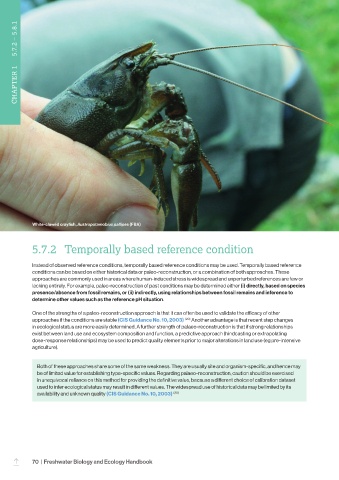
            White-clawed crayfish, Austropotamobius pallipes (FBA)


            5.7.2  Temporally based reference condition


            Instead of observed reference conditions, temporally based reference conditions may be used. Temporally based reference
            conditions can be based on either historical data or paleo-reconstruction, or a combination of both approaches. These
            approaches are commonly used in areas where human-induced stress is widespread and unperturbed references are few or
            lacking entirely. For example, paleo-reconstruction of past conditions may be determined either (i) directly, based on species
            presence/absence from fossil remains, or (ii) indirectly, using relationships between fossil remains and inference to
            determine other values such as the reference pH situation.

            One of the strengths of a paleo-reconstruction approach is that it can often be used to validate the efficacy of other
            approaches if the conditions are stable (CIS Guidance No. 10, 2003)  (20)  Another advantage is that recent step changes
            in ecological status are more easily determined. A further strength of palaeo-reconstruction is that if strong relationships
            exist between land use and ecosystem composition and function, a predictive approach (hindcasting or extrapolating
            dose-response relationships) may be used to predict quality elements prior to major alterations in land use (eg pre-intensive
            agriculture).


              Both of these approaches share some of the same weakness. They are usually site and organism-specific, and hence may
              be of limited value for establishing type-specific values. Regarding palaeo-reconstruction, caution should be exercised
              in unequivocal reliance on this method for providing the definitive value, because a different choice of calibration dataset
              used to infer ecological status may result in different values. The widespread use of historical data may be limited by its
              availability and unknown quality (CIS Guidance No. 10, 2003)   (20)


            70  |  Freshwater Biology and Ecology Handbook
      –

