


Page 162 - Freshwater-Biology-and-Ecology-Handbook
P. 162
CHAPTER 3     3.3.1  3.3.1  Adjustment of predictions


            In adjustment, we standardise the predictions at the
                                                              We can calculate the environmental quality to which a
                                                              prediction relates from biologists’ assessment values
            environmental quality represented by High/Good status
                                                              (Figure 3.14). These quantify the environmental quality for
            boundary, defined as the median value of the index or metric
                                                              each RIVPACS reference site when the reference samples
            across all RIVPACS III+ reference sites (GB + NI + Highlands
            and Islands), as explained in Section 4.2. This median is the
            environmental quality that RIVPACS predicts most reliably.
                                                              Good boundary quality, in intervals of half-a-status class
                                                              (see key in Figure 3.14). Biologists’ assessment values
            The adjustment acknowledges that WFD reference state   were collected in terms of their deviation from the High/
            is a specific environmental quality but not what that quality   were estimated for every RIVPACS reference site using
            is. The next step, conversion (Section 3.3.2), converts this   contemporary environmental data (mostly chemical) and
            standardised RIVPACS prediction to the environmental   assessments by the biologists who collected the reference
            quality defined by reference.                     samples, based on descriptive definitions covering water
                                                              quality, land use and, as a backstop, biological indicators.
            Predictions for individual sites are adjusted by adding   They were also screened against either the North Europe
            or subtracting an amount that depends on how far the   or the Central-Baltic Geographical Intercalibration Group
            environmental quality of their predictions deviate from   (GIG) type-specific chemical, flow and land cover criteria for
            the High/Good boundary. We know the value of EQRs   defining WFD reference state, depending on their hydro-
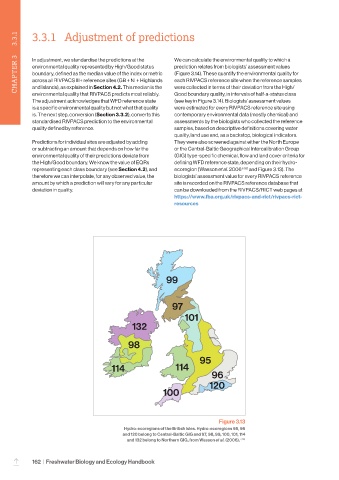
            representing each class boundary (see Section 4.2), and   ecoregion (Wasson et al. 2006  (48)  and Figure 3.13). The
            therefore we can interpolate, for any observed value, the   biologists’ assessment value for every RIVPACS reference
            amount by which a prediction will vary for any particular   site is recorded on the RIVPACS reference database that
            deviation in quality.                             can be downloaded from the RIVPACS/RICT web pages at
                                                              https://www.fba.org.uk/rivpacs-and-rict/rivpacs-rict-
                                                              resources


                                                           99


                                                             97
                                                                  101
                                               132


                                              98


                                                                       95
                                        114                    114
                                                                           96
                                                                           120
                                                          100


                                                                              Figure 3.13
                                             Hydro-ecoregions of the British Isles. Hydro-ecoregions 95, 96
                                            and 120 belong to Central-Baltic GIG and 97, 98, 99, 100, 101, 114
                                              and 132 belong to Northern GIG, from Wasson et al. (2006).  (48)


            162  |  Freshwater Biology and Ecology Handbook
      –

